Our approach

How we work

How large an enclosure should be, when we feed, or whether we can take on another animal: for us, all of this rests on the same four principles.

On this page we describe these four principles and, for each of them, what they look like in practice. A separate section covers wild animals, because working with them is entirely different, and another covers what we do not do.

The four principles

The order is not a ranking. We take all four into account in every decision, and when they conflict, what the animal needs in that situation decides.

  1. Calm and predictability

    An injured or recovering animal needs calm to heal just as much as it needs treatment. Stress slows recovery, so our days follow the same routine, and our animals are always cared for by the same people.

    In practice

    • If a visit, a photo shoot or a demonstration would not be good for the animal, it does not happen.
    • Feeding and a health check in the morning; enclosures, medication and check-ups during the day; a closing round in the evening. The same every day.
    • Animals that are ill or recovering are checked at night too.
  2. Individual care

    Many of our animals came to us precisely because their condition does not fit into a standard care routine. Each of them gets a diet, a place and treatment adapted to their condition, and if their condition changes, we rethink their care too.

    In practice

    • We buy almost all the food ourselves, for each animal according to its own diet.
    • For dogs with spinal injuries: post-operative rehabilitation, hydrotherapy and a wheelchair.
    • Our blind dogs wear a harness with a hoop around the head that reaches the wall before their nose does.
  3. Gradual improvement

    Whatever the budget allows, we use to improve conditions: enclosures, fences, roofs, floors. We go step by step, and always start where it matters most to the animals.

    In practice

    • The materials for renovating one enclosure cost about HUF 350,000.
    • We do the work ourselves and pay no contractor labour.
    • In 2025 we spent HUF 2,478,820 on the site and its infrastructure.
  4. A skilled daily routine

    Most of care is repetitive work that requires precision and expertise. Medication has to be given on time, changes have to be noticed and written down. This cannot be done in a rush, nor shared out among many hands.

    In practice

    • Medication at precise times, observation, record-keeping.
    • Feeding is also the first check of the day: it is when we find out if someone is not eating.
    • Check-ups, dressing changes and therapy are part of the daily routine, not special events.
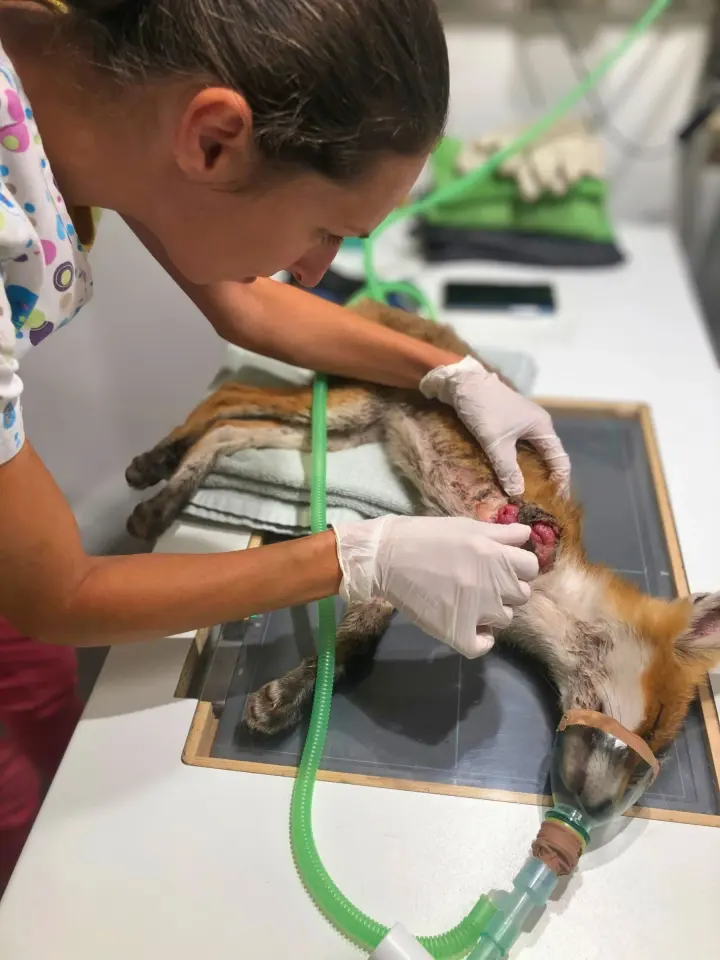
Our vet treating an injured red fox.
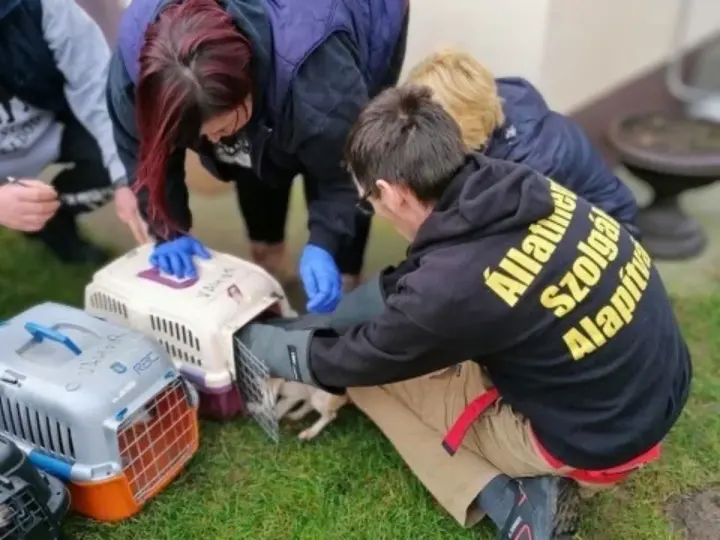
Miki putting a dog into a transport crate during the clearance of a puppy farm
During the clearance of a puppy farm, Miki puts a dog into a transport crate.

How a day runs from morning to night is described on the Care page.

Wildlife rehabilitation

With wild animals, the aim is release

The aim of rehabilitating a wild animal is that, wherever possible, it can return to nature and live there independently. How much contact it can have with people in the meantime depends on whether it can be released.

If the animal can be released

We have only as much contact with it as its treatment and feeding require. Where possible, it grows up with others of its species and gradually gets used to its natural environment again.

It is especially important that a young animal does not imprint on people and does not get used to our presence. This is not harmless tameness but a rehabilitation problem: a wild animal that is used to people does not keep away from us, seeks our company, and is in far greater danger once released.

For us, a good outcome is a young animal we have raised that avoids people. That gives it a chance to thrive in the wild.

If it cannot be released

Some cannot be released because of a permanent injury, and some grew up in captivity and so could not survive in the wild. They stay with us.

With them, too, we keep only as much contact as examination, treatment and safe care require, and we try to make these situations as stress-free as possible. We do not build a closer relationship than that, and we do not turn them into pets.

Limits

What we do not do

We write these limits down in advance so that we can be held to them.

We do not rehome at any cost
If one of our animals could have a good owner, we look for a home for it. But an animal that needs care no adopter could reasonably be expected to provide stays with us. When rehoming, the question is whether the animal will be better off afterwards.
We do not take on more animals than we can care for
We have sixteen places: 8 dog rooms, 1 cat enclosure, 6 fox enclosures and 1 aviary. The same two people know every animal in our care. If there is no space, or no one to care for another animal, we say no, even when it is hard. In an overcrowded facility, every animal living there is worse off.
We do not accustom wild animals to people
We do not tame them, and we do not turn a wild animal into a pet, even if it stays with us for good.
We do not shock or pressure
We do not publish shocking images, and we do not raise money with urgent appeals. Both work in the short term, but in the long term they damage the credibility of the whole sector. On our animals’ pages, alongside the injury, we always show where the animal is now.

We show our figures too

On the Transparency page you can see what we spent in 2025 and how our income and expenditure have developed since 2014. All fourteen of our annual reports can be downloaded.