Advocacy

Beyond rescue

In our rescue work we keep running into gaps that no further rescue can fix. A rule is missing, a shared register is missing, public data is missing. So alongside rescue, we work on four cases.

For each one we set out what the problem is, what is missing, what we are doing and where it stands, with dates and sources. What we submit, we publish.

Case · grants to civil society

Those who knew an e‑mail address received money.

Those who did not, never knew about it.

NEA-E

individual ministerial decisions of the NEA: 391 decisions, HUF 2.32 billion awarded in 2026

All individual ministerial decisions: 560, HUF 22.35 billion, without a public call.

Under consultation

  • NEA-E decisions (391)
  • other discretionary (169)

Harm caused by legislation

Can the state be sued if a civil society organisation did not know about a funding opportunity?
The four cases

Two legal cases, two platforms

Each case answers the same four questions. The problem and Where it stands are facts, with sources on the case's own page; What is missing is our position, and in the grants case that of the study's authors.

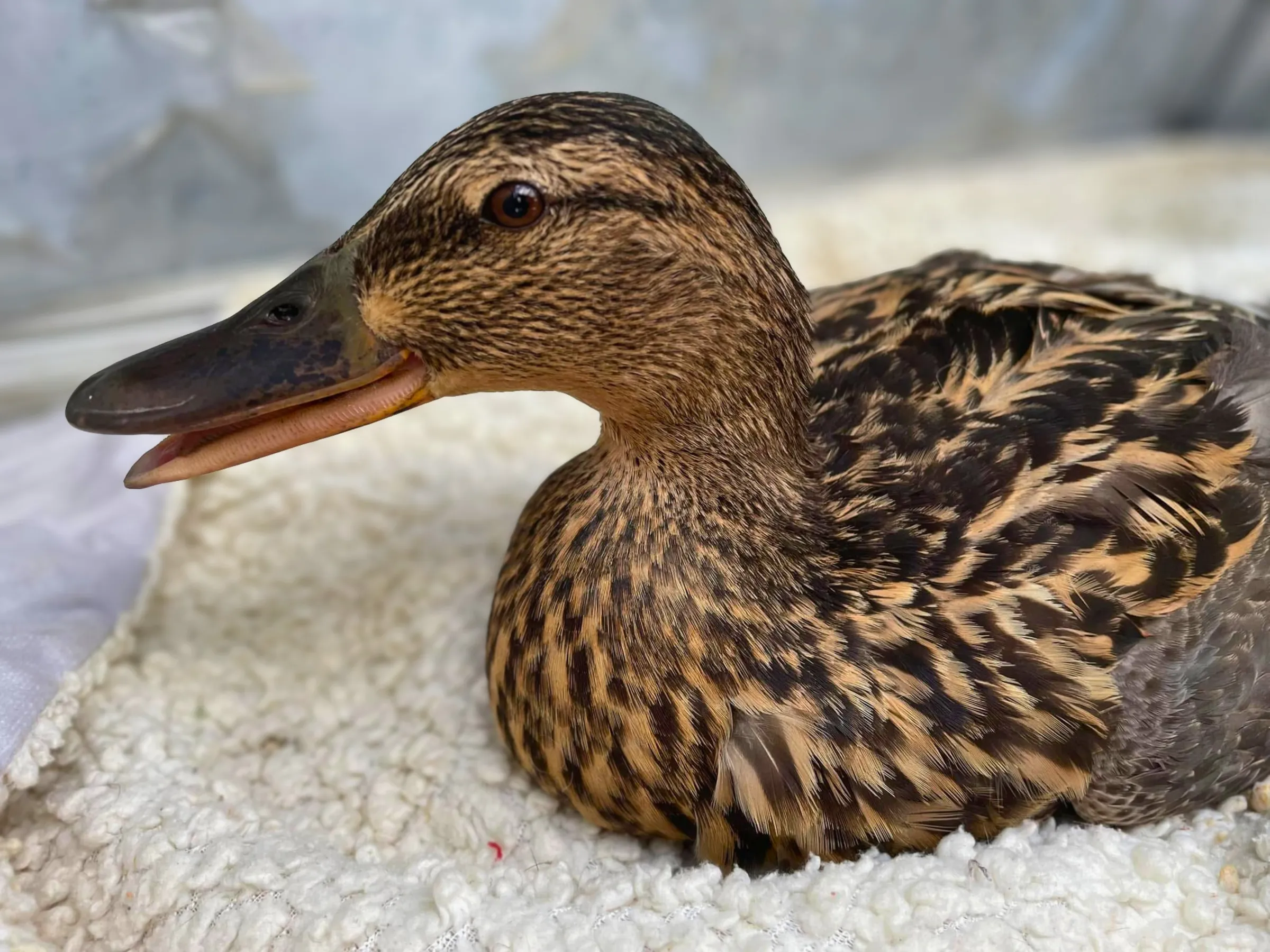
A mallard seen from the side, sitting on a soft blanket, its bill slightly open.

Legislative initiative

Wildlife rehabilitation

Where the law is silent

Awaiting a replyConsultation at the Ministry for the Living Environment · 4 November 2026Legal analysis and arguments sent · 11 November 2026

The problem
The law does not allow an injured or orphaned wild animal to be captured, transported, admitted to a rehabilitation facility or kept. The law is silent on rescue, but not on keeping.
What is missing
Statutory authorisation that makes the four points of the rescue chain lawful, together with the implementing rules that go with it.
What we are doing
We requested data from the authorities, compared the relevant rules of all 27 EU Member States, and wrote a ten-section draft bill amending three Acts.
Where it stands
On 8 September 2026 we sent the initiative and the draft to the Ministry of Agriculture and Food Economy (Agrár- és Élelmiszergazdaságért Felelős Minisztérium) and the Ministry for the Living Environment (Élő Környezetért Felelős Minisztérium). The Ministry of Agriculture and Food Economy registered it and replied. Professional consultation with the State Secretariat for Biodiversity of the Ministry for the Living Environment began on 4 November 2026.
The four steps of a rescue. Today the law permits none of them.
  1. Captureat the sceneno legal basis
  2. Transportto the rehabilitation facilityno legal basis
  3. Admissionat the rehabilitation facilityno legal basis
  4. Keepinguntil recoveryno legal basis

Source type: Official reply

~36,000 protected wild animals were admitted to rehabilitation facilities between 2023 and 2025.Requests for data of public interest (FOI requests), 24 data providers

Platform

TNR Register

A shared register of cat colonies

Example: 10 of 12 cats neutered

Working

The problem
Trap–neuter–return (TNR) work for stray and community cats is currently done organisation by organisation, in isolation. There is no common record of where colonies are, how large they are, or how many cats in them are neutered.
What is missing
A verifiable system in which a colony can be followed from the first report to follow-up, and which shows the neutering rate, not just the number of operations.
What we are doing
The TNR Register is our own development: reporting without registration, colony and cat records, trapping rounds, neutering offers from veterinarians. We fund the server and the entire technical background.
Where it stands
It is working: anyone can report unowned cats, and organisations and veterinary clinics can register. The platform is available at tnrregiszter.hu. In preparation: aggregated data for decision-makers.
The same ten neuterings, two different resultsillustrative example

10 / 100 cats: ten out of a hundred neutered

10%

10 / 12 cats: ten out of twelve neutered

83%

The number of operations is the same. The neutering rate is not. That is what we need to be able to measure.

Platform

Know who you give to

Data on animal welfare organisations in one place

Available, in development

The problem
A would-be donor cannot see in one place what an animal welfare organisation has published about itself: the annual report is on the court's website, the day-to-day work is on social media, and there is nothing in between.
What is missing
A profile for every organisation, in a uniform structure and with sources, showing how much information about it is public, and how much is not.
What we are doing
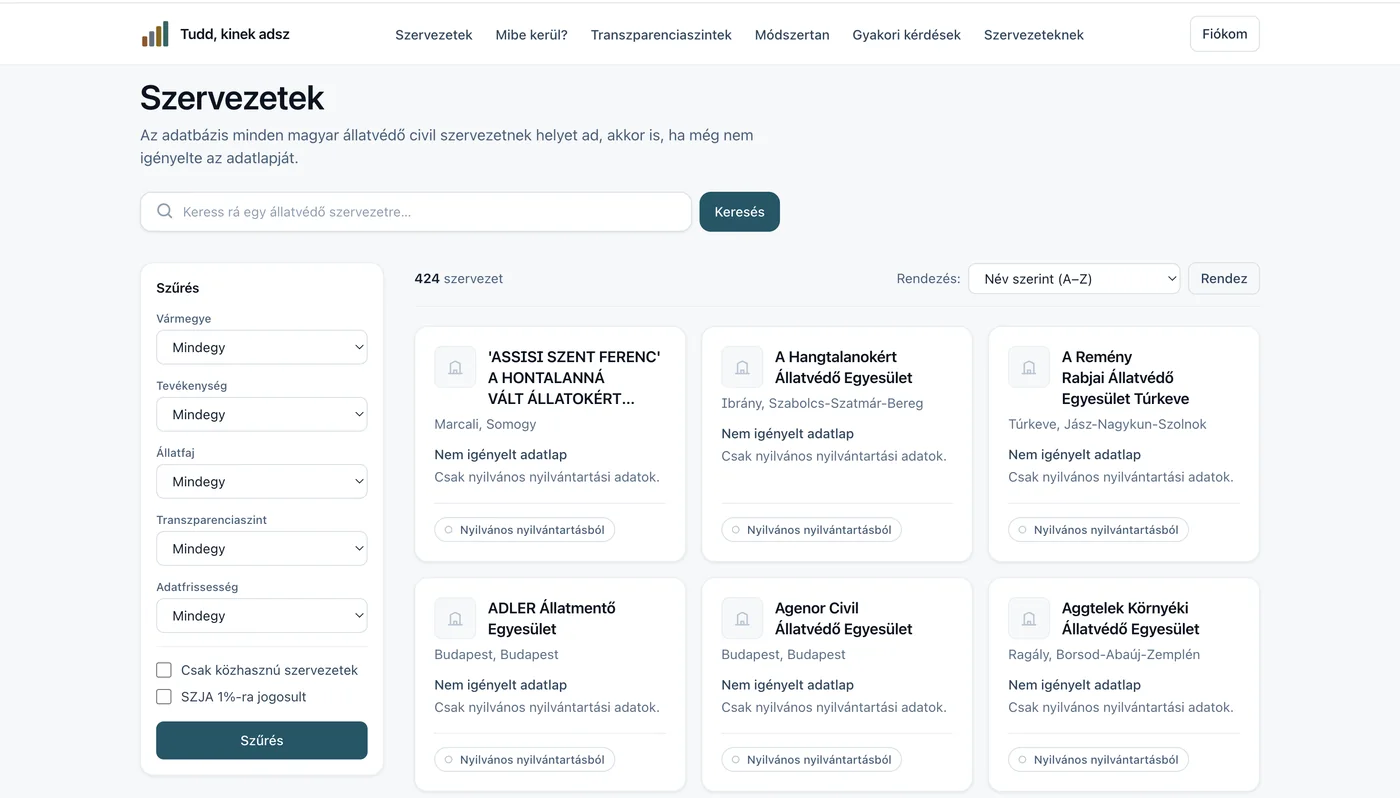
We built the Know who you give to platform (Tudd, kinek adsz): a profile drawn from public registers, five transparency levels, seven topics on professional work, and a source next to every item of data.
Where it stands
Available since September 2026 and under continuous testing and development: 424 organisations can claim their own profile. Viewing is free and requires no registration. In development: a downloadable profile, a badge, and comparison between years.
The Organisations page of Know who you give to: search, filters and organisation cards
The platform's Organisations page, September 2026.
424
organisation profiles that can be claimed
5
transparency levels
7
topics on professional work
HUF 0
to view

Legal study · grants to civil society

Harm caused by legislation

NEA-E · 2026Ministerialindividual grantCall for applications—Deadline—Eligibility—Decisionthe ministerJustification—NO CALL FORAPPLICATIONS391decisionsHUF 2,322,149,217total awarded in the 391decisions · 2026Source: Közpénzportál,summary in the study NEA-E · 2026Ministerialindividual grantCall for applications—Deadline—Eligibility—Decisionthe ministerJustification—NO CALL FORAPPLICATIONS391decisionsHUF 2,322,149,217total awarded in the 391decisions · 2026Source: Közpénzportál, summary inthe study

Under consultation

The problem
Part of the central funding for civil society organisations is awarded by discretionary ministerial decision, without any prior public call. An organisation that did not know about the opportunity could not apply.
What is missing
In the study authors’ view, the discretionary channel also needs safeguards of prior publication and equal opportunity: a public statement of intent, mandatory prior information and a duty to give reasons.
What we are doing
At the request of animal welfare organisations, we examined in a legal study whether the state can be sued over this. The answer under the law in force: no. Change is up to the legislature.
Where it stands
The study was published in 2026 and is free to download. A package of proposals is being prepared; consultation with the Ministry for Community Relations and Culture is under way.

Source type: Research

560
discretionary ministerial decisions
HUF 22.35 billion
in funding awarded

Based on the public 2026 beneficiary dataset, as compiled in the study.

A civil society organisation can receive central funding through seven channels. Two require a prior public call; five do not.

Can the state be sued for this? The study's answer: not under the law in force.

Timeline

The steps so far, with dates

The steps of all four cases on one timeline, oldest first. The highlighted point is the most recent step; the dashed one is the deadline ahead of us. Only steps that have actually happened and can be dated are included.

The full course of the wildlife rehabilitation case: Case status

  1. 17 March 2025
    Official inspection at our rehabilitation facility

    We had to prove the origin of the foxes in our care. This made it clear that the rescue of huntable species rests on tolerated practice alone, without a legal basis.

    Wildlife rehabilitation
  2. March 2026
    First version of ‘Where the law is silent’

    A blog post on the legal vacuum; FOI requests to the government offices, the national park directorates and the ministry.

    Wildlife rehabilitation
  3. 24 March 2026VgF/134-1/2026
    The Ministry of Agriculture replied

    The Game Management Department of the Ministry of Agriculture: the Hunting Act (Vtv.) and its implementing decree do not regulate keeping for rescue and care purposes.

    Wildlife rehabilitation
  4. 25 March 2026
    Question to the hunting authority

    We asked Pest County Government Office in writing about rescuing and keeping injured animals of huntable species.

    Wildlife rehabilitation
  5. April 2026
    The question: can the state be sued?

    Data requests by animal welfare organisations revealed that there had been an address to which applications for discretionary grants could be submitted. Those who knew about it could use it. The organisations came to us with the question of whether the state could be sued.

    Harm caused by legislation
  6. 4 May 2026PE/FE/00334-2/2026
    The hunting authority's reply

    Rescue is unlawful; there is no route through an individual permit, a decision on grounds of equity or hunting association consent either.

    Wildlife rehabilitation
  7. 21 May 2026
    The EU transposition deadline passed

    The transposition deadline of Directive (EU) 2024/1203 on the protection of the environment through criminal law.

    Wildlife rehabilitation
  8. Summer 2026
    Comparison of the rules in all 27 EU Member States

    Using a uniform coding system, we compared the relevant rules of all 27 EU Member States and contacted their authorities; fourteen Member States sent a substantive reply.

    Wildlife rehabilitation
  9. 27 July 2026replies: 17 and 19 August
    Enquiry to the European Commission

    We asked whether there is an EU route for the closed, permanent placement of a captured invasive animal. There is.

    Wildlife rehabilitation
  10. 2026year of the study
    ‘Harm caused by legislation’ published

    A 32-page legal study by two authors. The answer: under the law in force, the state cannot be sued.

    Harm caused by legislation
  11. September 2026
    Know who you give to becomes available

    The Organisations page lists every Hungarian animal welfare civil society organisation, including those that have not yet claimed their profile.

    Know who you give to
  12. 1 September 2026T/568
    The Government submitted the Criminal Code amendment

    A new set of rules on environmental offences; entry into force: 20 November.

    Wildlife rehabilitation
  13. 8 September 2026
    We sent the initiative

    The initiative and a ten-section draft bill, sent to the Ministry of Agriculture and Food Economy and the Ministry for the Living Environment.

    Wildlife rehabilitation
  14. 28 September 2026HVgF/20/2026
    The Ministry of Agriculture and Food Economy repliedWildlife rehabilitation
  15. 21 October 2026
    The Criminal Code amendment was promulgatedWildlife rehabilitation
  16. 26 October 2026
    The Ministry for the Living Environment repliedWildlife rehabilitation
  17. 4 November 2026
    Professional consultation with the State Secretariat for Biodiversity of the Ministry for the Living EnvironmentWildlife rehabilitation
  18. 11 November 2026
    Legal analysis and arguments sentWildlife rehabilitation
  19. 20 November 2026deadline
    The Criminal Code amendment entered into force

    Unlawfully keeping huntable birds above a value threshold, and keeping invasive animals, is in certain cases a criminal offence. The legal basis should have been created by this date.

    Wildlife rehabilitation

How we work

Data first, then a proposal

We follow the same order in every case. We do not put forward opinions but proposals backed by evidence, and we correspond with ministries, authorities and professionals in writing, with dates and file numbers.

Evidence labels

Above quoted passages and figures we state what type of source supports them. The exact source is given below: the body, the file number and the date.

  • Official reply: a written reply from an authority or ministry to our enquiry, with a file number
  • Legislation in force: what must be applied today
  • Draft legislation: what we propose; not yet law
  • Research: our own comparative study, a legal study or the professional literature
  • Published report: a public document that can be checked independently
  • Own records: our day-to-day administration
  1. 01

    Data

    FOI requests, public registers, our own field experience. Where there is no data, we ask in writing.

  2. 02

    Analysis

    From the data received and the law in force, we build a measurable picture. What cannot be supported does not go in.

  3. 03

    Comparison

    We look at how the same problem is solved in other Member States or in other fields.

  4. 04

    Proposal or tool

    Draft legislation with an explanatory memorandum, a legal study, or a working platform if the gap is a practical one.

  5. 05

    Publication

    We publish what we submit, even if we receive no reply.

Official replies

We asked two state bodies about wildlife rescue

In spring 2026 we asked the agriculture ministry and the hunting authority in writing about rescuing injured animals of huntable species. According to one reply there is no procedure for rescue; according to the other, the law does not regulate it.

Source type: Official reply

Under the legislation in force, there is no procedure or legal instrument that would allow animals of huntable species to be rescued or kept, temporarily or permanently, on the basis of an individual assessment.

Pest County Government Office, Agricultural Department · information · PE/FE/00334-2/2026 · 4 May 2026 · the full letter in the Document library

However, the Hunting Act (Vtv.) and its implementing decree (Vhr.) do not regulate the keeping of huntable animal species for rescue and care purposes.

Ministry of Agriculture, Game Management Department · information · VgF/134-1/2026 · 24 March 2026 · the full letter in the Document library

Public documents

Our submissions and the replies

All five documents can be downloaded. For each one, the Document library explains what it is, who issued it, why, and what role it plays in the case. It also lists which materials are not yet public, and why.

Open the Document library

  • Source type: Draft legislation

    Initiative for the legal regulation of the rescue and rehabilitation of wild animals

    The initiative as sent: the problem, the proposed solution and our request to the Ministry of Agriculture and Food Economy and the Ministry for the Living Environment.

    Állatmentő Szolgálat Alapítvány7 September 2026PDF · 3 pages · 58 kB · Document in Hungarian

  • Source type: Draft legislation

    Draft bill, first stage, with explanatory memorandum

    Ten sections amending three Acts. A proposal, not law in force.

    Állatmentő Szolgálat Alapítvány7 September 2026PDF · 8 pages · 77 kB · Document in Hungarian

  • Source type: Official reply

    The Ministry of Agriculture's reply

    For information, not a formal opinion: hunting law does not regulate keeping for rescue purposes.

    Ministry of Agriculture, Game Management Department · VgF/134-1/202624 March 2026PDF · 281 kB · Document in Hungarian

  • Source type: Official reply

    The reply of Pest County Government Office

    For information, not a formal opinion: there is no route through an individual permit or a decision on grounds of equity either.

    Pest County Government Office, Agricultural Department · PE/FE/00334-2/20264 May 2026PDF · 770 kB · Document in Hungarian

  • Source type: Research

    Harm caused by legislation: a legal study

    Can the state be sued if an organisation did not know about a discretionary grant opportunity? Ten chapters, with an answer.

    Dr Cecília Kajó LL.M. · Edina Némedi2026PDF · 32 pages · 596 kB · Document in Hungarian

If you have an animal in your hands right now

Have you found an injured or orphaned wild animal?

This page is about our legal work. If you have just found an injured bird, a fawn lying alone or a weakened fox cub, do not take it home and do not try to treat it yourself: ask first. Many young animals are not orphans; they only look like it.

Share

If you think it matters, pass it on

Every step of all four cases is public, with dates and documents. The link shows anyone where they stand.

We do this work with donations

Data requests, analysis, legislative drafting and the development of the two platforms are funded by donations, not by grants.

The drafts are proposals. Every provision requires professional and legal review; preparing legislation is the task of the competent ministries.