 Állatmentő Szolgálat
Cats
Our cats arrived with serious injuries, illnesses or difficult pasts. One lives on three legs, another with one eye, and for some, rebuilding trust took longer than healing the wound.
Where they come from
Some came to us from a dog pound (ebrendészeti telep), one from between the railway tracks, and one as a side story of a dog rescue.
- August 2019 Mara From a stairwell in a block of flats, where the residents asked for help for her.
- 2020 Szonja She came to us from the dog pound on Illatos út in Budapest.
- 2020 Váltó One front leg and one hind leg were caught in a set of railway points.
- October 2021 Kesu By then, one of his eyes had already been destroyed.
- 2022 Csongor On the way to a puppy farm, he crept out from under a railway carriage at Szolnok station.
- 2023 Mufurc From Budapest's 17th district, where he roamed the neighbourhood for months with a huge wound on his neck. Catching him took the persistence of several residents.
- Early 2025 Cella When the dog rescue shelter in Gyömrő was closed down.
You can read about how unowned animals are caught and housed today in our article Stray animals and dog control.
What they arrived with
Each name takes you to the cat's own page.


What patience means
Trust cannot be rushed: how much closeness fits into a day is different for each cat.
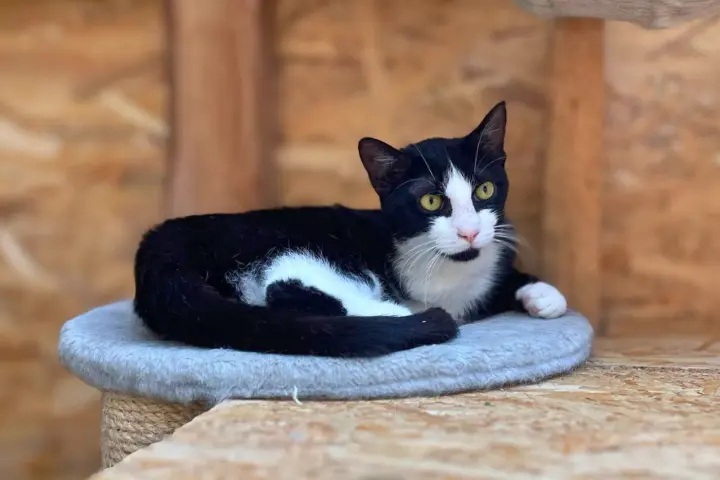
It took years before Váltó would even stay out in the enclosure while we were there. Even today he is only calm if we keep a distance of a metre or two and move slowly and predictably. He has not become a cat who asks to sit on your lap, and he probably never will.
Nor is that the goal: we want him to have a life in which he can feel safe while keeping his own boundaries.
Cella is still not fond of people, but with us she now behaves predictably. Szonja decides for herself how much closeness fits into her day, unless food comes into the picture. Kesu and Csongor are the opposite: they seek out human company of their own accord, and Csongor says hello with his nose.
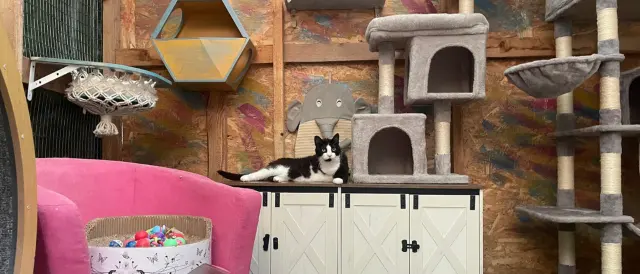
In the large cat enclosure the shelves, climbing wall and beds are at several heights, so everyone can find their own place and their own distance. Szonja, too, likes to watch from up high.
Caring for the cats is a monthly cost too.
Medication, check-ups, a special diet – every month, for years.