 Állatmentő Szolgálat
Background
How we got to the draft bill
This campaign did not start from an abstract insight, but from an official inspection and a few foxes. The first version of the text below was published on the Foundation’s blog in March 2026 (the original article in Knowledge & Research). Since then the official replies have arrived, the legislative package has been completed, we have sent the initiative to the Ministry of Agriculture and Food Economy (Agrár- és Élelmiszergazdaságért Felelős Minisztérium) and the Ministry for the Living Environment (Élő Környezetért Felelős Minisztérium), and the amendment to the Criminal Code (Btk.) has been promulgated. We have added these developments to the text.
I.
The first fox
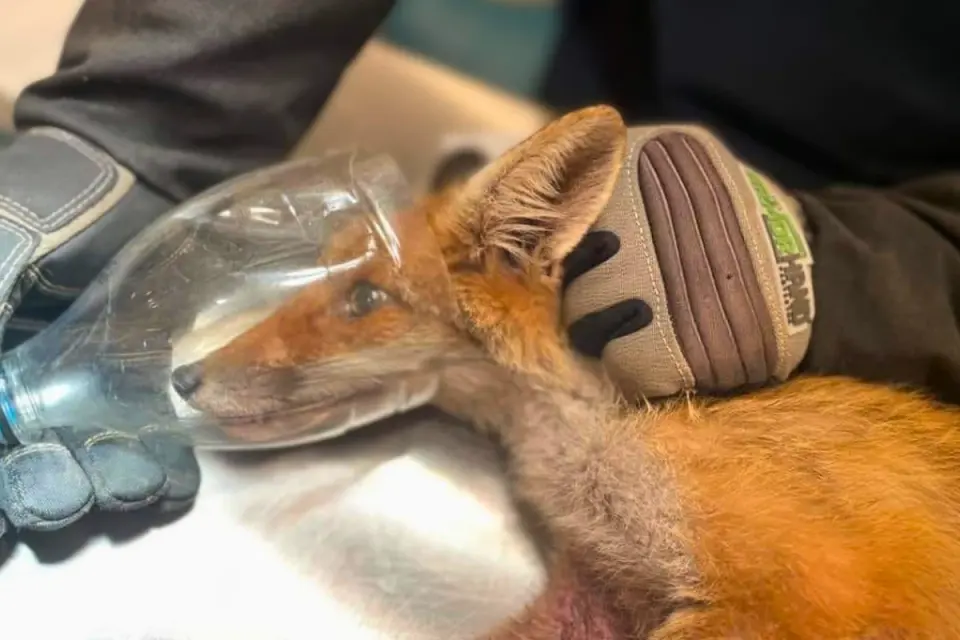
In 2016 the first wild-born fox cub came to us. Like many other people, probably, our first instinctive wish was to somehow win over this small, huffing, feisty cub.
At the time we did not yet know that this would not help it. Wildlife rescuers abroad with more experience drew our attention to the fact that raising a wild-born animal as a pet is not in the fox’s interest. The fox is a self-willed animal with a need for freedom, and with instincts it needs to survive in the wild.
The real challenge is not to tame a fox cub. The real challenge is the opposite: to preserve its natural fear of humans. A cub raised to be used to people becomes more curious about humans, while its caution towards danger weakens. The internal alarm system that warns a wild fox to be careful is dulled, and in the wild this is fatal. Such an animal ventures closer to people, dogs and roads, and does not recognise a threat in time.
II.
What the literature says
Source type: Research
In a 1995 study by Robertson and Harris, 251 captive-reared foxes were released into the wild. The result was sobering: of the 251 marked foxes, 90 were recovered, with a low survival rate, and in the period after release road traffic accidents were the main cause of death.
Research and rehabilitation practice published since then reach a similar conclusion. If people do not keep enough distance while rearing the cubs, the likelihood that the released animal will die within a short time increases significantly.
International wildlife rehabilitation protocols have answers to this, developed over decades: minimising habituation to people, socialisation with conspecifics, and gradual reacclimatisation to the wild. These are no longer principles but proven methods. The aim is not for the animal to get used to people, but for it to be able to survive on its own.
III.
The official inspection
On 17 March 2025 we received an unannounced visit. The official veterinarian examined the documentation of the foxes in our care, and we had to prove their origin. We had to demonstrate that these foxes had not come to us from the wild, and so were not part of Hungary’s game population.
That was when it became entirely clear that in Hungary the rescue of huntable species operates on the basis of tolerated practice. In practice, it happens countless times that animal rescuers or professionals help animals in trouble belonging to the species listed in the Hunting Act (Vtv.), yet the legislation gives no clear authorisation for this. For years we were able to work in the belief that our work was carried out within acceptable bounds. This was reinforced by the fact that in many cases the authorities asked us for help, and still do to this day.
In early 2025 our attention was drawn to the fact that we may not bring wild-living animals of huntable species onto our premises. These were species whose needs, behaviour and ethology we know well, and which we would be able to care for responsibly. There are foxes in our care, but they have never lived in the wild. What we do not know is what consequences it would have for them if we rescued a wild fox.
IV.
The legal vacuum
The Hunting Act, that is, Act LV of 1996 on the Protection of Wild Game, Game Management and Hunting (Vtv.), names exactly four types of facility in which huntable species may lawfully be kept: the game park (vadaskert), the wildlife park (vadaspark), the game farm (vadfarm) and the small-game rearing facility (apróvadtartó telep). Each has a clearly defined function: breeding, display, utilisation, hunting.
One thing is missing from this system. The Act does not create a type of institution whose task would be the rescue and rehabilitation of injured or orphaned animals of huntable species. The rules know exactly how game is to be managed, bred, displayed and utilised for economic purposes. But they do not say what can be done with the life of an animal in trouble.
The implementing decree, FVM Decree 79/2004 (V. 4.), lists the species that may be kept in an enclosed game-keeping facility: the big game species, plus the pheasant, the grey partridge, the red-legged partridge and the mallard. What it does not contain is at least as telling.
Source type: Legislation in force
The four facility types of the Hunting Act (Act LV of 1996), and what is missing from it
- game park
- wildlife park
- game farm
- small-game rearing facility
Their common purposes: breeding, display, utilisation, hunting.
These species have been completely forgotten. They cannot be kept ANYWHERE.
not in a game park, not in a wildlife park, not on a game farm, not in a small-game rearing facility, not in a zoo, not in a rescue centre. NOWHERE.
What the rules on enclosed game-keeping do not cover
Huntable species that are not among the species that may be kept in an enclosed game-keeping facility.
- European rabbit
- greylag goose
- bean goose
- greater white-fronted goose
- Canada goose
- Egyptian goose
- Eurasian coot
- Eurasian woodcock
- Eurasian collared dove
- common wood pigeon
- European polecat
- beech marten
- European badger
- red fox
- golden jackal
- muskrat
- raccoon dog
- raccoon
- hooded crow
- Eurasian magpie
- Eurasian jay
The legal vacuum is analysed in detail by Dr Cecília Kajó and Edina Némedi in their article ‘Vadállatmentés jogi vákuumban’ [Wildlife rescue in a legal vacuum] (Jogi Fórum, 20 March 2026; in Hungarian).
V.
When two pieces of legislation do not know about each other
FVM Decree 164/2008 (XII. 20.) on the rules of protection against rabies provides, as a matter of course, for how captured foxes are to be housed and vaccinated. It regulates their identification, their housing and their compulsory vaccination.
So one piece of legislation describes in detail how a captured fox is to be cared for, while according to another the very situation to which the first applies cannot legally arise. The care of the fox is regulated, but the possibility of care has not been created.
Source type: Legislation in force
A captured fox between two pieces of legislation
Housing, identification and compulsory vaccination of the captured fox: regulated.
The situation to which the first applies, namely care for rescue purposes, cannot legally arise.
The Animal Protection Act, Act XXVIII of 1998 on the Protection and Humane Treatment of Animals (Ávtv.), also belongs here. Its provisions apply to huntable species subject to the differences laid down in the Hunting Act, which in practice means that the hunting legislation governs questions relating to game management. At the same time, the prohibition of unjustified suffering appears in the Hungarian legal system as a general principle applying to all vertebrate animals. However, no legal framework has been created that would make it possible to rescue injured or orphaned animals of huntable species, so for certain animals there is no working tool for giving effect to animal protection principles.
The situation is different for protected species. For hedgehogs, bats and birds of prey there is an established rescue and rehabilitation practice, and injured animals can be cared for within a more orderly framework. For huntable species, however, the rules are built on the management and utilisation of game stocks, not on saving individual lives.
VI.
There was an opportunity, and it was missed
The question of rescuing huntable species hardly appears in parliamentary documents. In a speech on 13 June 2022 it was said that an appropriate solution should be found for saving healthy or injured game that strays into settlements.
The legislature did deliver an answer in December 2025. On 10 December 2025 Parliament (Országgyűlés) adopted Act XCVII of 2025, which entered into force on 24 December. The Act deals with wild animals that stray into built-up areas, but only those that cause damage or pose a risk for reasons of public or animal health or public safety. Capture and, where necessary, killing are the task of the mayor; before any killing the police station must be notified in advance, and the mayor notifies the holder of hunting rights and the hunting authority.
The Act also contains an apparent alternative: the captured animal may be relocated to a hunting ground, with the prior consent of the holder of hunting rights and the permission of the hunting authority. On paper this is a more humane solution. In practice, however, a wild animal in shock cannot wait while the mayor finds the competent game manager, obtains consent, and the authority then grants permission. This is not a matter of hours but of days. And where is it kept in the meantime? The Act gives no answer, because there is still no facility that could operate for rescue purposes.
Moreover, in the case of wild animals the phrase ‘poses a risk’ is extremely broad. From a public and animal health perspective, in principle any animal of a huntable species can pose a risk, a wood pigeon just as much as a fox or a roe deer. The Act does not narrow this down and sets no professional criteria, so the assessment is left to the mayor.
The amendment makes no mention whatsoever of animal protection organisations, rescue centres or zoos. Yet this would have been the opportunity to finally bring the concept of rescue into the Hunting Act, under official supervision and with an obligation to account. It would not have taken much effort. It works in other Member States.
VII. · What has happened since
The questions became draft legislation
The original version of the article ended with a request for data of public interest. The replies have arrived, and they did not refute what is set out above; they confirmed it.
March 2026
The Ministry of Agriculture replied
Source type: Official reply
The Game Management Department of the Ministry of Agriculture (Agrárminisztérium) stated in writing that the Hunting Act and its implementing decree do not regulate the keeping of huntable animal species for rescue and care purposes.
May 2026
The hunting authority replied
Source type: Official reply
The Agricultural Department of Pest County Government Office classified rescue as unlawful, and also ruled out the routes of an individual permit, consent from a hunting association and a decision on grounds of equity.
Summer 2026
We looked at the other EU Member States
We compared the relevant rules of all 27 EU Member States and contacted their competent authorities. It turned out that no Member State prohibits rescue, and that Hungary is the only one where the law gives no answer to this question.
September 2026
We sent the proposal
We drew up the full legislative package, and on 8 September we sent the first-stage legislative amendment to the Ministry of Agriculture and Food Economy and the Ministry for the Living Environment. The Ministry of Agriculture and Food Economy registered it and replied on 28 September.
October 2026
The Criminal Code amendment was promulgated
On 21 October Act LXVI of 2026 was promulgated; it entered into force on 20 November. Unlawfully keeping huntable birds is a criminal offence once the value threshold is reached, and the explanatory memorandum to the Act names the magpie as an example. On 26 October the State Secretariat for Biodiversity of the Ministry for the Living Environment replied to our submission by e-mail; professional consultation began on 4 November.
The two official letters are information, not formal opinions: the authority decides in individual cases and does not issue legal interpretations. Both letters can be read in the Document library.
The starting point has not changed. In Hungary there is still no legal framework that would allow a weakened fox cub, an injured beech marten or an injured magpie chick to be taken into care for rescue purposes and, after rehabilitation, to return to the wild. The knowledge exists, the professional protocols exist, and so do the people who could care for these animals responsibly.
What is missing is a few paragraphs in the legislation. We have written those few paragraphs.
The drafts are proposals. Every provision requires professional and legal review; preparing legislation is the task of the competent ministries.