 Állatmentő Szolgálat
Platform
Know who you give to
We do not tell you whom to give to. We show you what you can know about them.
It shows in one place, in a uniform structure, what data an animal welfare organisation has published about itself – so that anyone who wants to give does not have to rely on guesswork. This page explains why it was needed, what already works, what is in preparation, and what we deliberately will not build.
In brief
- The problemfact
A would-be donor cannot see in one place what an animal welfare organisation has published about itself: the annual report is on the court's website, the day-to-day work is on social media, and there is nothing in between.
- What is missingour position
A profile for every organisation, in a uniform structure and with sources, showing how much information about it is public – and how much is not.
- What we are doing
We built the Know who you give to platform (Tudd, kinek adsz): a profile drawn from public registers, five transparency levels, seven topics on professional work, and a source next to every item of data.
- Where it stands
- Available, in development
Available since September 2026 and under continuous testing and development: 424 organisations can claim their own profile. Viewing is free and requires no registration. In development: a downloadable profile, a badge, and comparison between years.
- 424organisation profiles that can be claimed
- 5transparency levels
- 7topics on professional work
- HUF 0to complete and to view
The problem
Anyone who wants to donate today has nothing to look at.
A donor almost never learns what became of their money. Not because organisations are secretive – but because there is nowhere for them to show it. The annual report is a PDF on the court's website, the day-to-day work is a Facebook post, and in between there is nothing.
In principle the data is public: annual reports, public benefit reports, grant lists. In practice, though, it sits in several different places, in different formats and at different depths – or nowhere at all. Anyone who wants to check has to spend hours searching and still ends up without a comparable picture. A taxpayer making their 1% personal income tax designation is flying just as blind.
Where the data is today
- Annual report
A PDF on the court's website.
- Public benefit report
Public in principle – if you can find it.
- Grant list
Wherever it happened to be published.
- Organisation website
What the organisation publishes itself.
- Social media
The day-to-day work, one post at a time.
Five places, five formats, different depths. Anyone who wants to check has to spend hours searching.
This gap in trust is not the fault of individual organisations but of missing infrastructure. The Harm caused by legislation study describes the same gap from the side of the funding system: the path of public money is visible afterwards, not beforehand. Know who you give to approaches it from the other side – from the person who gives.
- Nowscattered sources
- Know who you give toone readable organisation profile
Where it came from
From a chapter in a publication to a platform
The concept was set out in our 2026 publication Etikus adománygyűjtés az állatvédelemben (Ethical fundraising in animal welfare), in a chapter titled ‘Átlátható Állatvédelem – egy hiányzó infrastruktúra’ (Transparent animal welfare – a missing infrastructure). The publication examines how campaigns built on shocking images lead to impulsive, unconsidered giving, and concludes that fundraising platforms solve the technical side, but there is a system-level problem that none of them addresses – the supporter cannot judge whom they are giving to.
- 01Research and publication
Ethical fundraising in animal welfare (Etikus adománygyűjtés az állatvédelemben) – Állatmentő Szolgálat Alapítvány, 2026.
- 02An information gap identified
The supporter cannot judge whom they are giving to.
- 03Available, in development
tuddkinekadsz.hu: available since September 2026, in development.
Source type: Research
The pressure does not come from the authorities – it comes from the wallet.
Three principles from the publication were kept
- Voluntary
A mandatory system would need an official operator and a legal basis, and waiting for that would mean doing nothing.
- Built on the financial report
Credibility rests on the report that civil society organisations are required to prepare anyway.
- Does not judge
It does not tell you whom to give to – it only shows what can be known.
The first round focuses on Hungarian animal welfare organisations, because this is the field we know. The system is built so that it can be extended to other areas of civil society.
Available
Available, and under continuous development
A public platform where you can see in one place what an animal welfare organisation has published about itself: how much money came in and what it was spent on, how many animals it cares for, where and in what conditions it keeps them, which of its documents are available, and what it has committed to for the coming year.
- A profile for every organisation
Basic data from public registers appears automatically. This requires no registration and no payment; after identification, an organisation can take over its own profile and add to it.
- Transparency levels
Five levels show how much the organisation has published about itself – each with an explanation of what it means.
- Finances in plain terms
The composition of income and expenditure, broken down into groups – a readable breakdown, not a spreadsheet to download.
- Seven topics on professional work
Care, housing, veterinary care, neutering, advocacy, education, legal aid. Not all of them have to be completed.
- A source next to every item
You can see what the organisation stated itself, what comes from a register, and which document we have checked.
- Own statement
- Public register
- Checked document
Project overview
What it looks like
Today – available
Available since September 2026 and under continuous testing and development: 424 organisation profiles can be viewed, and organisations can claim their own profile to show more about themselves. Our own profile is a good example of what a level means in practice: 24 of the 27 criteria are met, yet the level is Bronze, because one condition for Silver – the professional report – is still missing. The rule is the same for everyone, including us.
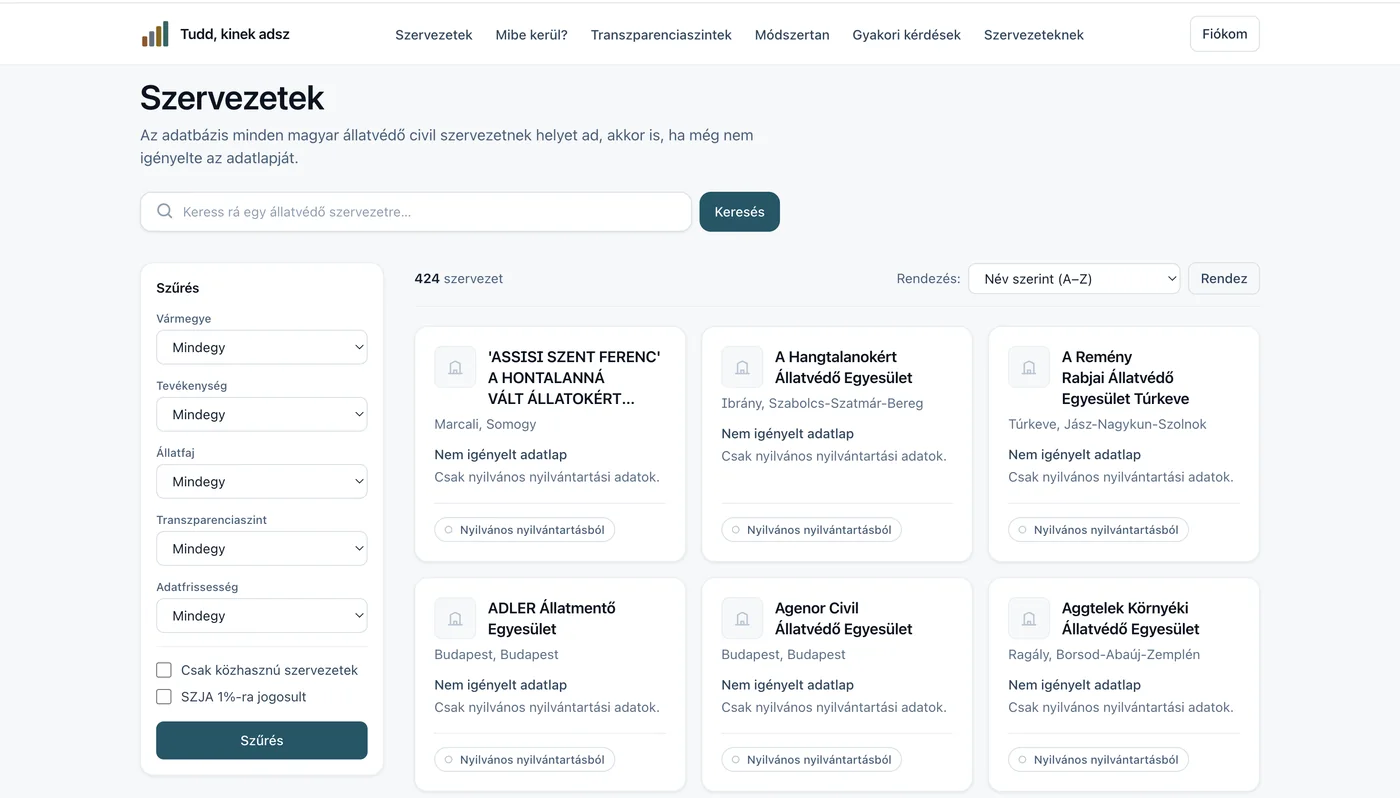
- Search and filters; every card shows its source – in this image, a public register.
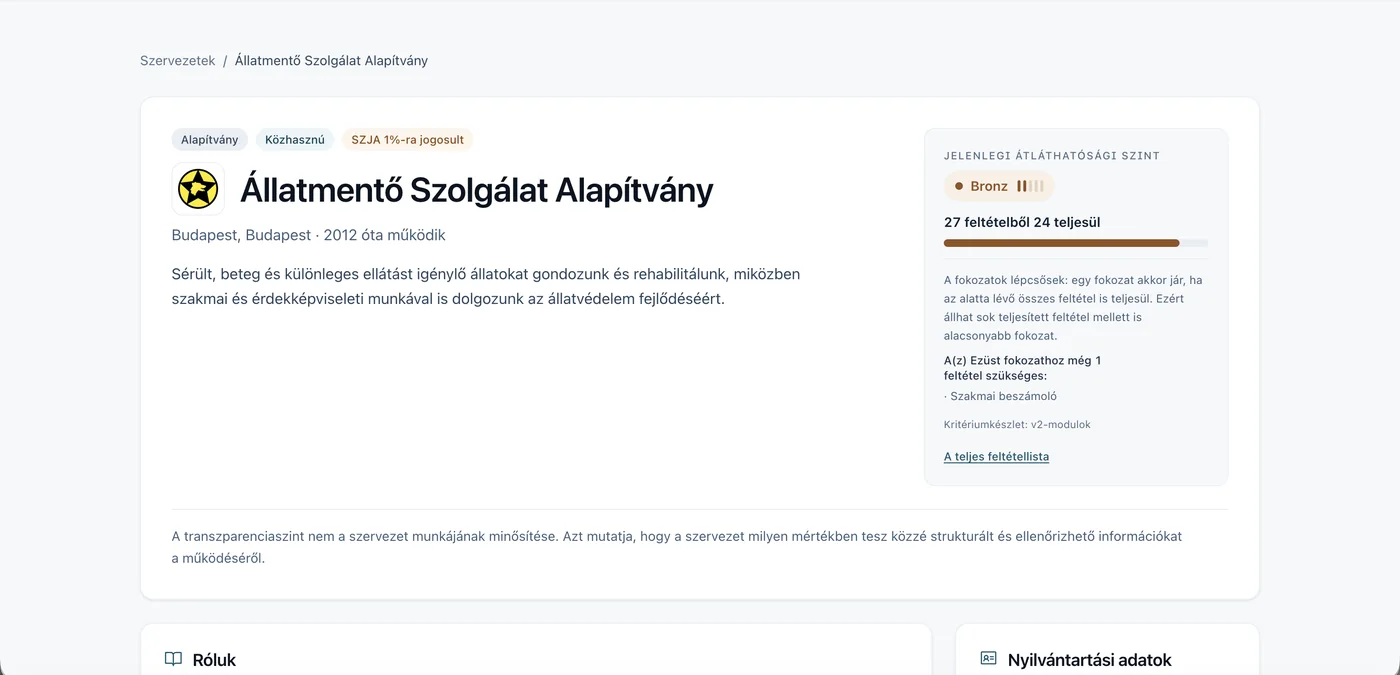
- Checked: 24 of the 27 criteria are met, yet the level is Bronze.
- Not yet published: the professional report. Not an error – this is what is missing for Silver.
Concept – not yet working
Design mock-ups of three planned features. These are not screenshots of working features but visual concepts from the development plan. The samples use the name Kőrisliget Állatmentő Alapítvány – a fictitious organisation; its data is not real.
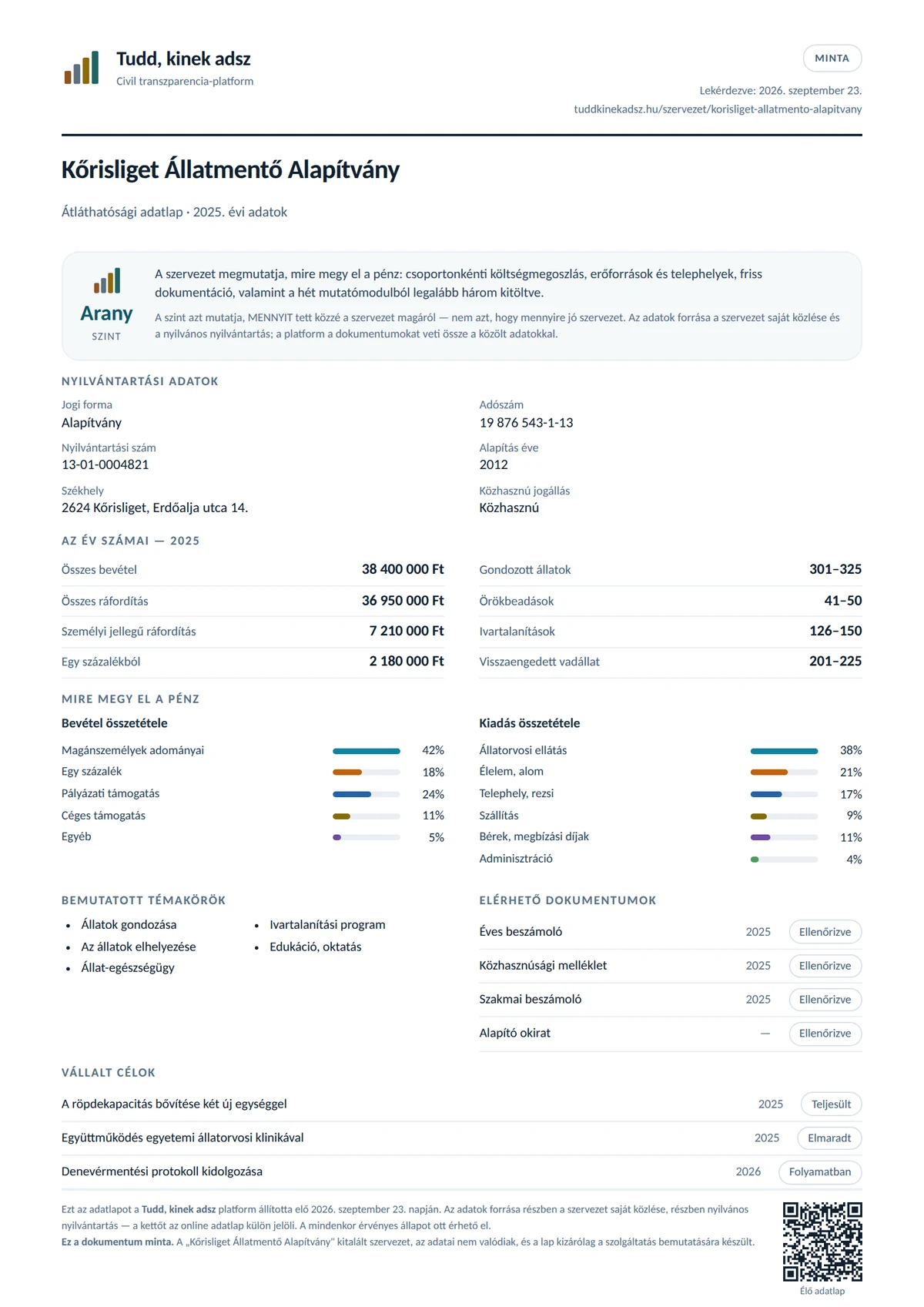
Planned feature. A single page, dated on the day it is generated and with a verification code: registration data, the year's figures, the composition of income and expenditure, the available documents, the goals committed to and what became of them. A QR code at the bottom of the page leads to the live profile.
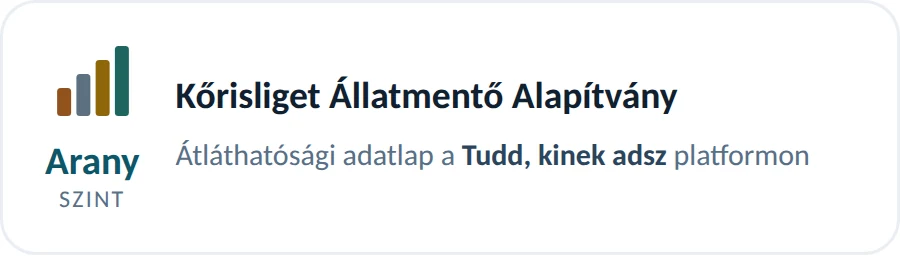
Planned feature. It shows the organisation's level on its own website and links to the profile. Live: if the level changes, it updates automatically; it collects no data about visitors.

Planned feature. It deliberately does not show the level: an e-mail circulates for months, and if the level changed in the meantime, it would state something untrue. It only says that the profile is available.
Transparency levels
The five levels
- Basic profile
- Bronze
- Silver
- Gold
- Platinum
- Basic profileCompiled from public data. Not a result but a starting point – which is why it is not in the logo.
- BronzeThe organisation has confirmed and supplemented its profile.
- SilverReports and basic data in full.
- GoldDetailed financial and operational data: cost breakdown by group, resources and sites, up-to-date documentation, at least three of the seven topics completed.
- PlatinumThe fullest publication, going back several years.
Methodology
What we check, and what we do not
We do not check whether the organisation does good work, but whether the data it publishes can be supported.
- Statement
- Source
- Comparison
- Labelling
- Profile
The platform compares the data an organisation provides with its documents: the annual report, the public benefit annex, the professional report and the founding document. What matches is labelled ‘checked’. What cannot be checked against a document appears as the organisation's own statement – it does not disappear; its source is simply visible.
There is one thing we deliberately do not calculate: the ‘cost per animal’. No two animals are alike, and no two cases are alike. This does not mean that an organisation cannot present its own expenditure in a way that makes it easy to picture. It means that organisations cannot be measured by this figure. A shelter, a wildlife rescuer and a neutering programme do quite different things with the same forint, and for those who take on the harder cases this figure will be higher, even though they are the ones doing more work. At a wild bird rescue, losses are naturally higher than at a dog shelter, and not because it does worse work. That is why the figures are accompanied by an explanation of what they mean.
Limits
What we will not build
- Not a ranking. We do not produce a ‘best animal welfare organisation’ list. The transparency level shows how much an organisation has published about itself – not how well it does its work. Confusing the two would do the most harm to the organisation that writes little but works hard.
- Not a score. Shelters, neutering programmes, wildlife rehabilitation, education, legal and advocacy work: five operating models, five cost structures. We do not give them a common score, because none of them is ‘better’ than another.
- No false precision. We do not ask for an exact figure where it would suggest false precision: most data is shown in ranges. A range cannot be used to compete, and it cannot be misused either.
- No assumed data. We do not publish data that the organisation has not provided, and we do not fill the gap with a zero or an estimate. An empty field is not an omission: it means that no statement has been made on that point.
- No paid seal. A level cannot be bought: completing a profile is free for organisations, and viewing is free for donors.
What we are working on
Development directions
With one exception, the features below are not yet available. They are part of the development plan and are shaped by feedback from organisations and donors. The status shows the stage of development, not how important the feature is.
- Availablealready working
- Nextdesign mock-up made
- Laterconcept
Available
already working, continuously expanding- A more detailed picture of professional work
We are already working on this: the topics are continually refined based on feedback from organisations. The platform is not limited to shelters, dogs and cats. Every organisation can show which animals it cares for, and what else it does: education, legal advice or lobbying.
- A more detailed picture of professional work
Next
a design mock-up has already been made- Downloadable transparency profile
Organisations put together the same information again and again: as an annex to grant applications, for the annual report, for approaches to supporters. Once they have published their data, they should not have to gather it by hand again. The date and the verification code are not a formality: a certificate is worth exactly as much as it can be verified.
- Embeddable live badge
It shows the organisation's level on its own website and links to its profile. If the organisation uploads this year's report or completes another topic, the badge updates automatically. It does not need replacing and does not go out of date.
- Image for the e-mail signature
A small image for an e-mail signature that links to the profile. It deliberately does not show the level – only that the organisation's profile is available, because that does not go out of date.
- Downloadable transparency profile
Later
a concept for now- Comparison between years
A single year's figures say little on their own. What says something is the direction an organisation is heading in: it will be possible to move between years on the profile and see side by side what has changed.
- Earlier year
- Later year
The logic of the feature: the same profile at two points in time, side by side. We show no figures here; those will come from the real profiles. - Goals committed to and what became of them
Organisations will be able to mark a commitment as in progress, achieved, partly achieved or not achieved, with a short explanation. Every change of status is recorded with a date. An unmet goal is nothing to be ashamed of: an organisation that states what did not work and why says more about itself than one that lists only its successes.
- Comparison between years
Joining
If your organisation would like to join
Taking over and completing a profile is free. Completing it is not one long form: it can be done topic by topic, a little at a time, and you do not have to complete them all. If there is a question that does not fit your work – or one that is missing – write to us: many of the breakdowns came from organisations' feedback.
We are building the platform with donations, not grants. A platform that makes civil society organisations' disclosures comparable is hard to run credibly for an organisation that applies to the same funding pots – so we publish about our own operations what we ask of others: fourteen years of reports, a breakdown of our expenditure and the path of the 1% designations are on our Transparency page. Viewing will always remain free.
Share
Send it to someone who is about to donate
A link anyone can use to see what an animal welfare organisation has published about itself – before they give.
This platform, too, is built with donations.
There is no grant behind it, and viewing will never cost anything. If you think it matters that donors can see whom they are giving to, support its development.
The illustrations on this page come from the platform's own visual system and do not show data of real organisations. The samples were made with fictitious data of a fictitious organisation.