 Állatmentő Szolgálat
Perhaps everything was fine just a few hours ago. Now you are sitting in a clinic corridor, or in the car park of an emergency clinic, and the vet has said the words: ‘We don’t know whether your dog will walk again.’
In the first hours you are flooded with information. You hear words you may never have heard before, such as spinal cord compression, deep pain perception and decompressive surgery. At the same time, quick decisions have to be made: should there be a CT or an MRI scan, should there be surgery, and how much will it cost? And even the simplest questions have no answer yet: how will the dog get home, how will it pee there, who will lift it when you have to go to work?
You don’t need to have all the answers right now. Most of the problems that seem impossible at the moment are tasks that can be learned.
Everyone who today confidently empties a dog’s bladder or adjusts a dog wheelchair once started out in this same place. So did we.
In this guide we go through, in order, what to do in the first hours, why it is urgent to find out what has happened, what is worth asking the vet, what you can expect, what care at home looks like, and how to tell whether your dog has a good life. We do not promise that everything will be fine. But we do promise that you will realise you are not alone. Many of us have been through this, and it would have been easier if we had known what nobody told us at the time.
What really frightens owners is often not what the vet tells them, but what nobody tells them. What will happen at home. Whether they will have to reorganise their whole life. Whether they will cope. To say it up front: the beginning is hard, but most tasks become routine within a few weeks, and you won’t have to turn your life upside down either. And the dog is not thinking about what it has lost. It wants to live just as before, without pain.
1. The first hours
If your dog suddenly cannot stand up, is dragging its hind legs, or its legs give way under it, take it to a vet the same day. If it happens at night, find an out-of-hours emergency service. Don’t wait until morning in the hope that it will have passed by the next day.
Set off immediately if
- the paralysis came on suddenly, or is getting worse over a matter of hours;
- the dog is visibly in pain, crying, or won’t let you touch its back;
- it happened after an accident, a fall or being hit by a vehicle;
- it is not peeing, or its belly is tense and bloated;
- it is breathing with difficulty or rapidly.
How should you carry it?
- On a flat, rigid surface: in a carrier, on a board, on a covered tray. A larger dog can also be carried on a blanket if two of you hold it taut.
- Support its body along its whole length. Don’t hold it only under the belly or the chest, because then its spine will bend.
- Don’t let it jump, crawl or thrash about. The less its spine moves now, the better.
A dog in pain may snap, even if it has never bitten anyone in its life. This is not a character flaw; it is pain. If necessary, put a muzzle on it.
What not to do
- Don’t give it any medicine on your own initiative. Especially not human painkillers (ibuprofen, diclofenac, naproxen): in dogs these can cause severe, even life-threatening poisoning.
- Don’t exercise it, don’t pull at its legs, don’t try to stand it up.
- Don’t wait for days.
What should you tell the vet?
Write it down on your phone, because people forget things at the clinic:
- When and how did it start? Suddenly or gradually? Has it got worse since?
- Has it peed since then, and how?
- Every medicine it has had in the past few weeks, especially painkillers, anti-inflammatories and steroids. Even if it was given at another clinic, or was only a single injection. We explain in Part 6 why this matters so much.
- If it is a rescue dog and you don’t know its history, say that too.
2. Why is it urgent to find out what has happened?
Paralysis is not a disease but a symptom. The same sight – a dog dragging its hind legs – can mean something completely different depending on what caused it. And what will help depends on that too.
The most common causes
- Disc herniation (intervertebral disc disease, IVDD). Between the vertebrae there are intervertebral discs that act as cushions. If the inner material of a disc ruptures out and pushes into the spinal canal, it compresses the spinal cord. This is the most common cause, especially in short-legged, long-backed breeds (Dachshund, French Bulldog, Pekingese), but it can happen in any dog. It is usually painful.
- Traumatic spinal injury. Being hit by a vehicle, a fall, a bite. It often comes with other injuries (broken ribs, chest or abdominal injuries), so the whole dog has to be examined. A pelvic fracture can also cause symptoms that involve paralysis.
- A sudden disruption of the spinal cord’s blood supply. In this case nothing is compressing the spinal cord; instead, one of its small blood vessels becomes blocked. It typically comes on during running or play, from one moment to the next, and after the first few hours it is usually no longer painful. A similar picture is seen when a small amount of disc material strikes the spinal cord with great force but does not compress it permanently. In these cases there is nothing to remove surgically.
- Other possible causes: inflammation of the spinal cord, a tumour, a developmental abnormality.
Why does this matter now?
Because these have to be treated in completely different ways:
- if a disc or a displaced vertebra is compressing the spinal cord, the pressure can often only be relieved by surgery;
- if a small blood vessel has become blocked, surgery does not help; recovery is supported by rehabilitation;
- if there is inflammation, a completely different medicine is needed;
- if the spine is fractured, it has to be stabilised.
From the outside these often look exactly the same. That is why it is not a good idea to treat on a ‘maybe it will help’ basis.
The reason for the urgency is simple: if something is compressing the spinal cord and the dog’s condition is getting worse, it can keep getting worse with every day that passes. There is no need to panic. But there must be no delay either.
3. What can the vet learn from the examination?
The first step is always a physical and a neurological examination. During it, the vet checks:
- whether the dog can stand and take steps, and whether it moves its legs voluntarily;
- what its reflexes are like;
- whether it puts its paw back in the right position when the paw is gently placed ‘wrongly’;
- where its back hurts;
- whether it feels touch and pain in its legs;
- what its bladder is like: full, tense, whether it can be emptied.
From this, the vet can infer which section of the spine the problem is likely to be in, and assess how much the dog’s movement and sensation are affected at present. This is not yet a diagnosis: exactly what has happened, and how extensive the damage is, can usually only be established with imaging.
Where is your dog now?
Severity is often described in grades. The numbering may differ from clinic to clinic; what matters is the content. It is worth asking which step your dog is on now:
- its back only hurts, but it can walk;
- it can walk, but unsteadily and weakly;
- it cannot walk, but it moves its legs;
- it does not move its legs, but it has deep pain perception;
- it does not move its legs, and it has no deep pain perception either.
The vet may repeat the examination hours or days later, because the condition can change.
4. Why might a CT or MRI scan be needed?
This is the point at which many owners start to hesitate. It is expensive, it requires general anaesthesia, and it isn’t available on every corner. Let’s look at why it is worth it.
A plain X-ray shows the bones. In most cases it will reveal a spinal fracture. But it does not reliably show a disc herniation, because the spinal cord and the extruded disc material are not visible on an X-ray, or only uncertainly. So a ‘clear’ X-ray does not mean there is no disc herniation.
CT and MRI show:
- whether anything is compressing the spinal cord;
- exactly where, how large it is, and on which side. The surgeon needs this to plan the operation;
- whether there is a lesion that should be treated without surgery (vascular occlusion, clinically fibrocartilaginous embolism (FCE), inflammation, a tumour).
The aim is to find out as soon as possible whether there is spinal cord compression or another lesion that requires surgery. And also if there isn’t: then the dog does not have to undergo unnecessary surgery.
Both scans require general anaesthesia. Many clinics organise things so that if the images show a lesion suitable for surgery, the dog can be operated on under the same anaesthetic. It is worth asking about this in advance.
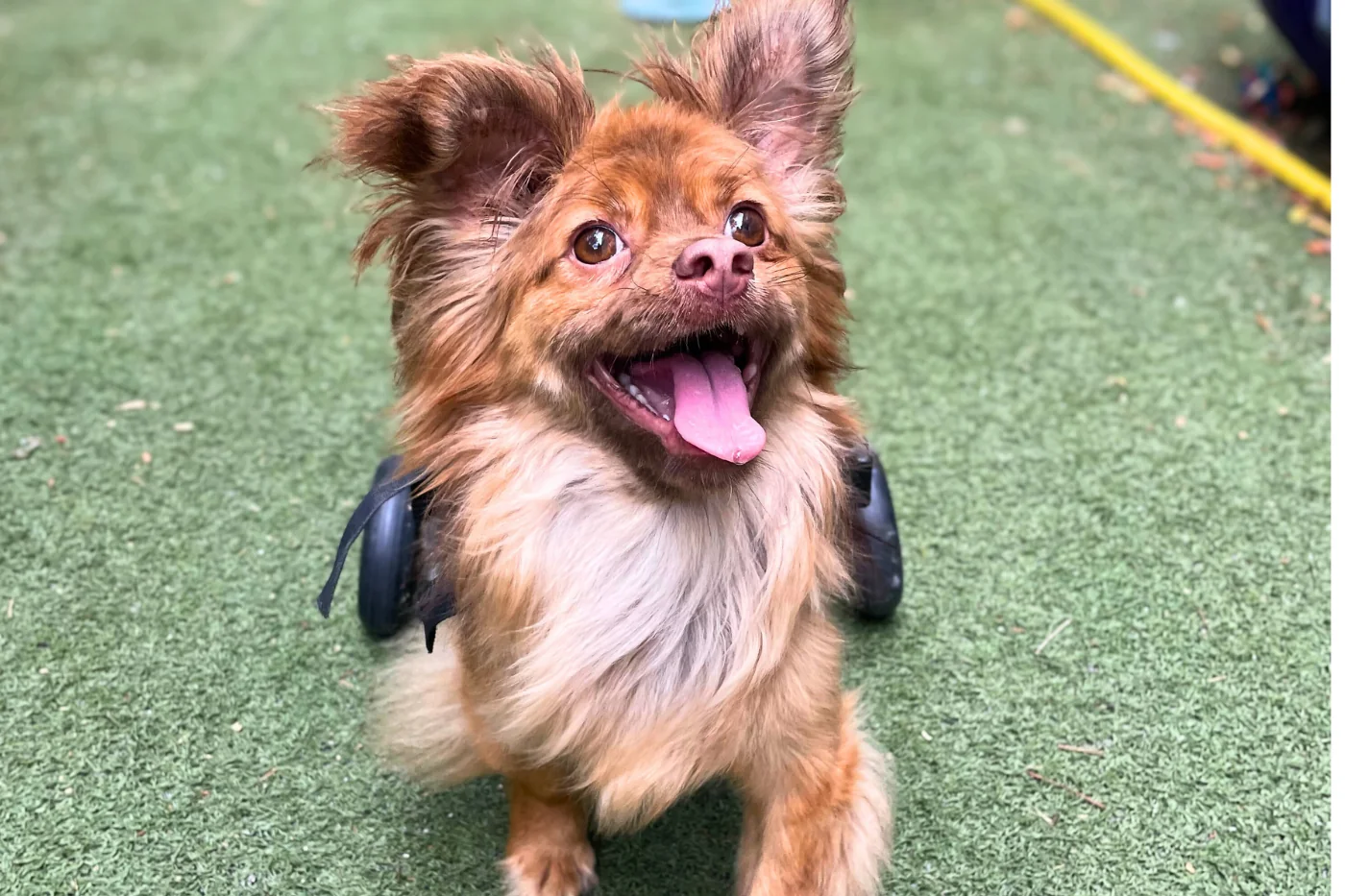
With Yoda we did not wait. In October 2024 he was found by the roadside near Bogács, severely neglected, and even the first pictures of him showed that he was not walking properly. He reached us in the evening and went for imaging the next morning. His spine was fractured, and his vertebrae had slipped over one another. Dr Tamás Ipolyi operated on him the same day. A displaced spinal fracture does not resolve on its own, and movement can cause further damage to the spine and the spinal cord. That is why, in a case like this, we do not wait.
What to ask
- Is a CT or MRI scan needed? Which one, and why?
- Where is the nearest place it is available, and how quickly?
- If it turns out that surgery is needed, can it be done at the same place? Even straight away?
- Roughly how much does the scan cost, and how much the surgery?
5. When is surgery considered, and why is it not good to wait without good reason?
If imaging shows that something is compressing the spinal cord and the dog cannot walk, the professional recommendation is usually surgery. In disc herniation, surgery removes the material causing the compression; in a fracture, it stabilises the spine. The body cannot do this by itself.
With surgery, dogs that cannot walk are more likely to regain the ability to walk, generally regain it faster, and the problem recurs less often.
How much time do we have?
On the internet you often read rigid deadlines: ‘within 12 hours’, ‘after 24 hours it’s too late’. The current professional literature does not support a time window that applies to every dog. Dogs have been described that walked again even when they were operated on after more than a week of paralysis. If your dog has already been paralysed for days, that in itself is not a reason to give up on surgery.
Waiting can have a cost, however. If something is compressing the spinal cord and the dog’s condition is getting worse, it can keep getting worse while you wait. What today is ‘cannot walk, but moves its legs’ may by tomorrow be ‘does not move its legs’, and by the day after ‘has no deep pain perception’. That is why diagnostic work-up and justified surgery must not be put off for days.
There is no need to rush, but you do need to move forward deliberately. The aim is to find out as soon as possible whether there is something to operate on. If there is, it should not slip by days.
If surgery is not possible
Sometimes surgery is not possible for financial, health or other reasons. That does not mean there is nothing to be done. Conservative treatment – strict restriction of movement for several weeks, pain relief, bladder care, careful nursing – can be a reasonable choice, and many dogs improve this way too. You should know, however, that in more severe cases the chances are better with surgery, and that during conservative treatment you also need to watch for signs of deterioration. If the dog gets worse, tell the vet immediately.
When does surgery not help?
When there is nothing to remove or stabilise: in vascular occlusion, with disc material that is not compressing the cord (acute non-compressive nucleus pulposus extrusion, ANNPE), in inflammation. In these cases the treatment is different. This, too, is shown by imaging.
6. Why is it not a good idea to give steroids without a diagnosis?
In our experience, it is still common in Hungary today for a paralysed dog to be given a steroid injection almost routinely (for example dexamethasone or prednisolone), often before anyone knows what has happened. The intention is understandable: steroids are powerful anti-inflammatories, and we feel that we have to do something.
This section is not against steroids. Steroids are important medicines, and there are situations in which they are justified, even indispensable – but that is decided by an accurate diagnosis.
The problem is the order. In acute paralysis, giving them without a diagnosis, routinely, on a ‘maybe it will help’ basis is not a good approach. For four reasons:
- It is not proven to help. In disc herniation and traumatic spinal injury there is not enough evidence that steroids protect the spinal cord or improve recovery. The international professional recommendation therefore does not recommend their routine use.
- It has a cost. With steroids, urinary tract infections and gastrointestinal side effects may be more common. In a paralysed dog whose bladder is already difficult to empty, this is no minor matter.
- It can affect surgery and recovery. The following paragraphs are about this.
- It can confuse the diagnosis. If the paralysis is caused by inflammation or certain tumours, a steroid given beforehand can change the test results, making it harder to find out what is wrong.
What does this mean if it later turns out that surgery is needed?
This is the part owners are told about least often. Yet it is a common situation: the dog receives a steroid injection at the first clinic, then imaging shows that a disc is compressing its spinal cord and surgery is needed.
- Pain relief options become narrower. One of the important tools of post-operative pain relief is non-steroidal anti-inflammatory drugs (NSAIDs, for example meloxicam, carprofen, robenacoxib). These must not be given together with a steroid or immediately after one, because this increases the risk of serious gastrointestinal complications, even stomach ulcers. In such cases it is usually necessary to wait until the effect of the steroid has worn off, and to rely on other drugs until then. This is manageable, but fewer options remain.
- The risk of certain complications may increase. Urinary tract infections may be more common with steroids. After surgery, when the dog’s bladder has to be helped to empty anyway, this can easily set recovery back. At higher doses, steroids can also affect the body’s defences against infection and wound healing. I have had the ‘fortune’ of seeing a dog that had been treated with steroids and had undergone spinal surgery, a few hours after its stitches were removed – and of seeing its spine too, because the tissues had not healed, and once the stitches were out its back had essentially split open.
- The start of rehabilitation can also be harder. Passive range-of-motion exercises and assisted standing begin in the first days after surgery. For this, the dog must not be in pain, and no infection or stomach trouble must get in the way. If the start is delayed because of these, the recovery period becomes harder too.
Precision matters here: we are not saying that steroids are ‘the work of the devil’. We are saying that steroids given unnecessarily can make treatment around surgery and the rehabilitation period harder, without offering any proven benefit in return.
If your dog has already had them
Don’t panic. You haven’t done anything wrong. Tell every vet who treats your dog from now on: what it was given, when and, if you know, how much. That is what matters most now.
If steroids are recommended, ask
- What diagnosis is this based on, and what do we expect from it?
- If surgery is needed later, will this affect pain relief?
- Has my dog already had a medicine that this cannot be combined with?
- How long does it need to be given, and how will it have to be stopped?
The last question is there for a reason. A longer course of steroids must not be stopped on your own, from one day to the next. During such a course the body suppresses its own cortisol production, and stopping suddenly can be dangerous. The tapering schedule is always set by the vet.
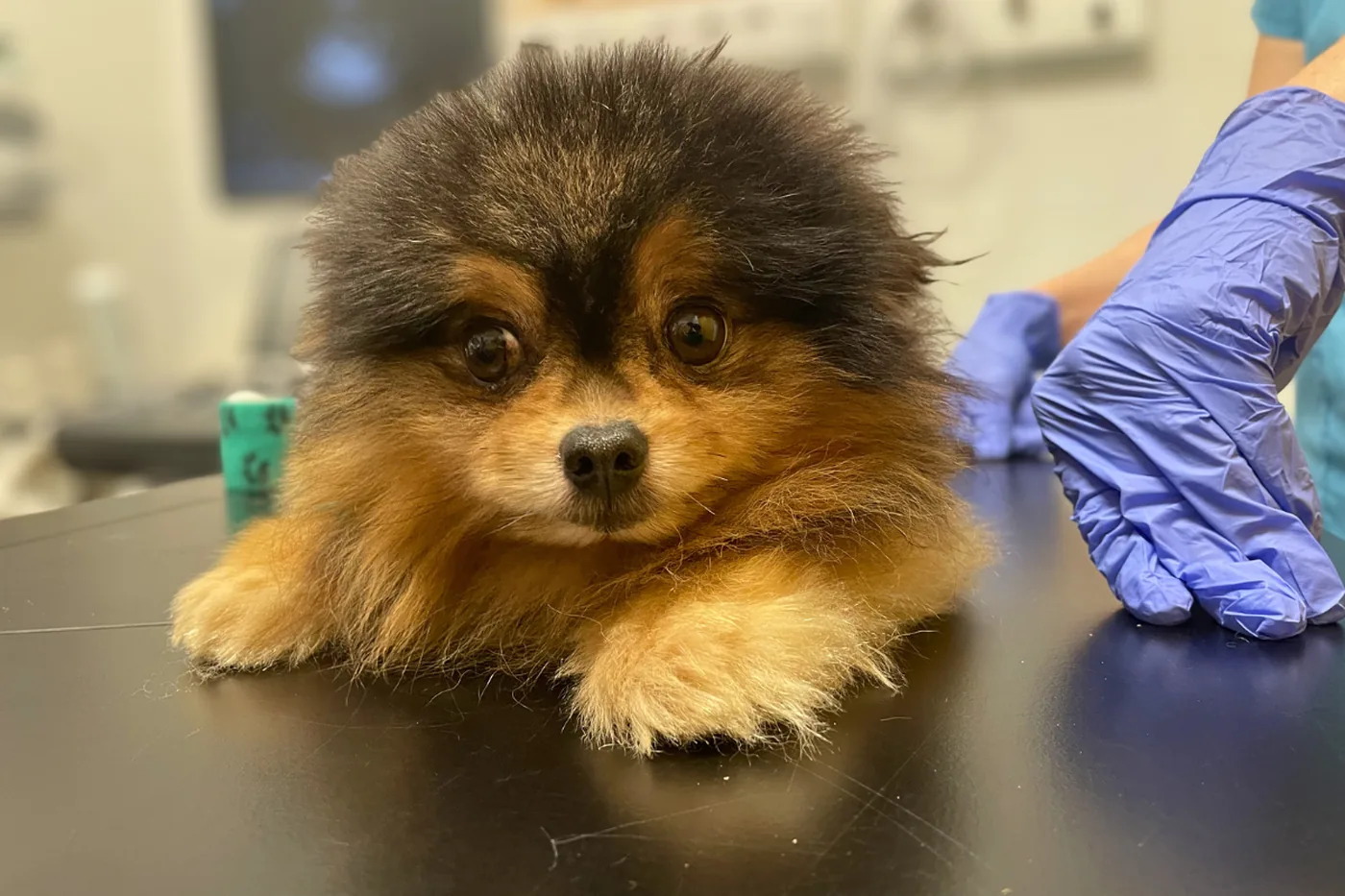
Joker, a six-year-old Pomeranian, is not paralysed, but with him this was exactly the question. He had previously been kept as a breeding stud, and he brought a great many health problems with him, including a liver enzyme value ten times the normal level. It was suspected that he may have been given steroids for a long time, which had then been stopped abruptly, and that his body was suffering from dependence. He had to be given steroids again, and then, under close monitoring with repeated laboratory tests and ultrasound, we weaned him off them step by step. His condition remained stable throughout.
7. What does deep pain perception mean?
You will almost certainly hear this term, and it will probably frighten you. Let’s calmly look at what it means. And what it doesn’t.
The test: the vet firmly pinches the dog’s toe with an instrument and watches whether the dog consciously perceives it: whether it turns its head, yelps or snaps. If it does, the dog is deep pain positive. If not, it is deep pain negative.
The dog pulling its leg back is not the same thing. Withdrawing the leg is a reflex that is produced through the part of the spinal cord below the injury, even when the signal no longer reaches the brain. A deep pain negative dog will also jerk its leg back while calmly gazing ahead. So don’t try this at home. It is easy to misread, and you can cause unnecessary pain.
Why is it so important?
The pathways that carry pain to the brain are the most resilient parts of the spinal cord. They are the last to be damaged. If the dog still has deep pain perception, the injury, however bad it looks, is not of the most severe degree. In disc herniation the chances are then very good. If it has none, that points to a severe injury, and the chances are worse.
But:
- it does not mean there is no hope. More than half of deep pain negative dogs operated on for disc herniation walk again;
- the cause matters. The figures for disc herniation cannot be transferred to a fracture or a vascular occlusion;
- one examination is not a final verdict. The condition can change in the first days, so the vet will reassess it;
- recovery takes time. If it does come back, it is often a matter of weeks, sometimes months.
8. Is there a chance that your dog will walk again?
This is the question you most want answered, as soon as possible. And it is the hardest one to answer precisely in the first days. The outcome depends on the cause, the severity and the treatment, and it often only becomes clear over weeks.
What we can say in general:
- Disc herniation, deep pain perception present: with surgery, the great majority walk again. Many do with conservative treatment too, but with a lower chance and more slowly.
- Disc herniation, deep pain perception absent: with surgery, more than half of them walk again. Without surgery this chance is much lower.
- Vascular occlusion: if some movement and sensation have been preserved, many dogs improve well. The outlook in the most severe cases is poor.
- Spinal fracture: very individual. It depends on the extent of the spinal cord injury, the type of fracture and any concurrent injuries.
Improvement often does not begin in the first days. In many dogs it takes weeks to become noticeable, in more severe cases months. Don’t decide on the basis of the first week.
It isn’t just ‘walks’ or ‘doesn’t walk’
We tend to think in two extremes. But mobility is a scale, and every step on it counts. It is progress if the dog holds its trunk more steadily, stands for a short time, moves a leg more actively, takes steps with support, empties its bladder or bowels better, or learns to get around well in its wheelchair.
Not every movement means that the spinal cord is healing. Kicking or stepping reflex movements are not in themselves an improvement, although they do work the muscles. Some dogs that remain deep pain negative long term eventually develop walking-like movement without voluntary control. This can be of practical use, but it is not the same as recovery. The treating vet or the rehabilitation specialist can help you make sense of what you are seeing.
It is worth measuring progress not only by whether the dog walks, but also by this: what can it do today that it could not do a month ago? Keep a simple diary. Slow changes can’t be seen from day to day, but looking back over a month, they can.
9. If your dog will not walk, can it still have a good life?
Yes. Not every dog, and not at any cost. But a great many can.
Rafi was our first dog about whom the verdict was that he would never walk. He arrived in 2019; his spine was fractured and his spinal cord severed. We were terribly afraid that he would suffer, that he would not have a good life, that we would not be up to it. Looking back, we can see that we brought most of the fear with us ourselves. We thought it through in our own terms – what this would be like for us – instead of starting from what he was showing us.
When a person loses the ability to walk, they measure it against their past, their plans, their former self. It is easy to project the same thing onto a dog and conclude: ‘this is no life’. We cannot know for certain exactly how a dog experiences paralysis from the inside. But we can see how it behaves.
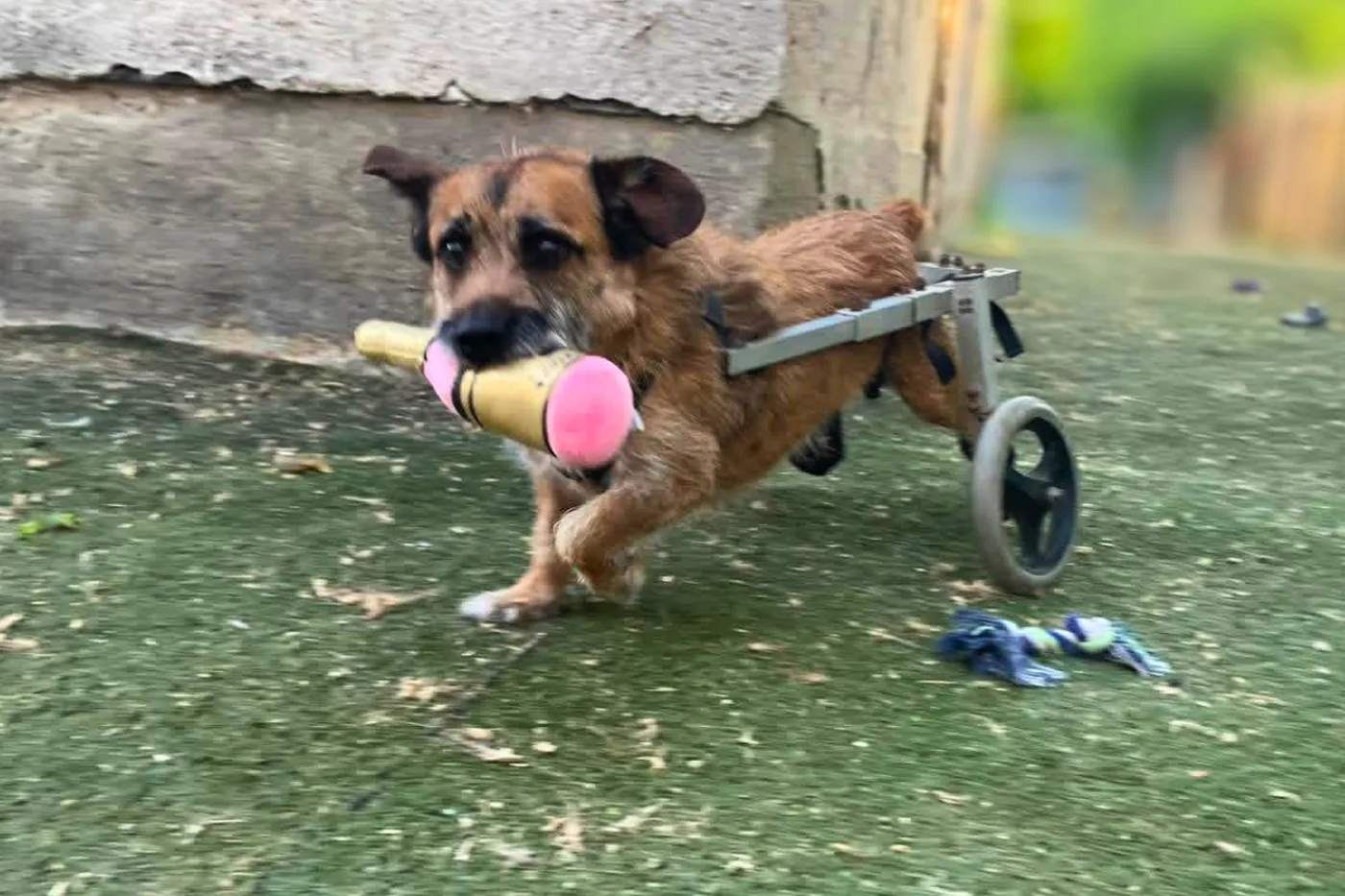
A dog does not measure itself against who it was yesterday, and it does not plan next year. It wants to eat, sniff, play, and be where the family is. Without pain. On wheels, if need be.
What should you look for if you want to judge its quality of life?
- Is it interested in its surroundings, and does it respond to familiar people and sounds?
- Does it take the initiative: does it come over (in its wheelchair, by crawling), and does it ask to be stroked?
- Does it play, and does it eat with appetite?
- Does it want to move, sniff and explore when given the chance?
- Does it show signs of lasting pain or stress: withdrawal, loss of appetite, panting at rest, restlessness, disturbed sleep, licking or chewing parts of its body?
If the answers to these are mostly good, that says far more about its life than whether it walks. If they are bad, that is a serious warning sign even if the dog can take steps.
A wheelchair is not a sign of giving up. It is there so that the dog can once again go wherever it wants by itself. Our job is not to be sad on its behalf. It is to make possible what it loves, to make sure nothing hurts, and to watch what it shows us.
One important thing that is rarely talked about: in a permanently paralysed dog, what often hurts later is not the paralysis itself but overload. The front legs, the shoulders and the neck work much harder than usual. This pain is real, and it can be treated, but it can also be prevented. A physiotherapist can help a great deal with this, in the long term too.
If the signs get worse
This is the hardest thing to talk about, but it belongs here. Paralysis in itself does not mean a bad life. But it is not true either that every paralysed dog can have a good quality of life. If pain cannot be adequately controlled, if recurring complications that are difficult to treat (urinary tract infections, pressure sores that won’t heal) dominate its days, if everything that brought it joy disappears, then sadly we may have to make a difficult decision. It can help to mark the good and the bad days on a calendar, because in difficult periods it is easy to lose clarity.
You don’t have to make that decision alone. The treating vet, the rehabilitation specialist and the people who know the dog will help make sure the decision is based on the dog’s real condition, not on fear or guilt. A well-founded decision, whichever way it goes, is part of responsibility.
10. The first weeks at home
What to expect – and what you needn’t
The first two or three weeks are the hardest, especially after surgery. Strict rest, medication, emptying the bladder several times a day, cleaning, turning, check-ups. It’s a lot. But it won’t stay like this.
Right now you have a few new things to learn, and so does your dog. What takes half an hour of nerves in the first week takes five minutes a month later. Most owners who today confidently empty their dog’s bladder did it with shaking hands the first time. So did we.
You don’t have to reorganise your whole life. What you need is a few new routines and a few good pieces of equipment. Owners of paralysed dogs go to work, keep other animals, and go out. And meanwhile the dog does not spend its time in a cage, but just as it did before.
What makes it easier?
- Having the techniques (bladder emptying, lifting, basic exercises) shown to you in person, and trying them yourself at the clinic, under supervision.
- Having one more person who can do the same. That way not everything depends on a single person.
- A fixed daily routine: emptying, feeding and exercises at roughly the same times every day. Bowel movements become more predictable too.
- A well-designed bed: washable, moisture-wicking pads, with several spares. Then cleaning is not a struggle but a swap. For us, a truly waterproof dog mattress was a godsend.
- Non-slip flooring, a ramp, a lifting harness. They spare your back and your dog’s.
- Fur clipped short on the hindquarters, if the dog is long-haired. It is much easier to keep clean.
- A diary. It shows progress, and helps if something changes.
- Ask. Animal welfare organisations, rehabilitation specialists, other owners. For almost every question you have, someone already has a tried-and-tested solution.
And something people often forget to mention: in many dogs, bladder control returns partly or fully. When it does, most of the daily tasks fall away.
The bladder – this matters most
Spinal cord injury often affects bladder function too. A paralysed dog often cannot empty its bladder, and urine is retained.
What misleads most owners
Urine dribbling does not mean the bladder is emptying. Because of the pressure, urine ‘overflows’ from the overfull bladder while a large volume stays inside. The owner sees the dog peeing, but in reality the bladder is not emptying.
Retained urine can cause urinary tract infection – the most common complication – and a paralysed dog often does not show the usual signs. In the longer term, the bladder wall can also be damaged.
The bladder can be emptied by hand, through the abdominal wall (manual bladder expression, in everyday speech simply ‘expressing’), or with a catheter. Which method, and how often, is for the vet to say – typically several times a day. This is not something to learn from an article. Ask for it to be demonstrated at the clinic, and practise with them until you feel confident.
Tell the vet if the urine is bloody, cloudy or strong-smelling, if the bladder becomes harder to empty, if the dog has a fever or is lethargic, or if it suddenly urinates much more or much less.
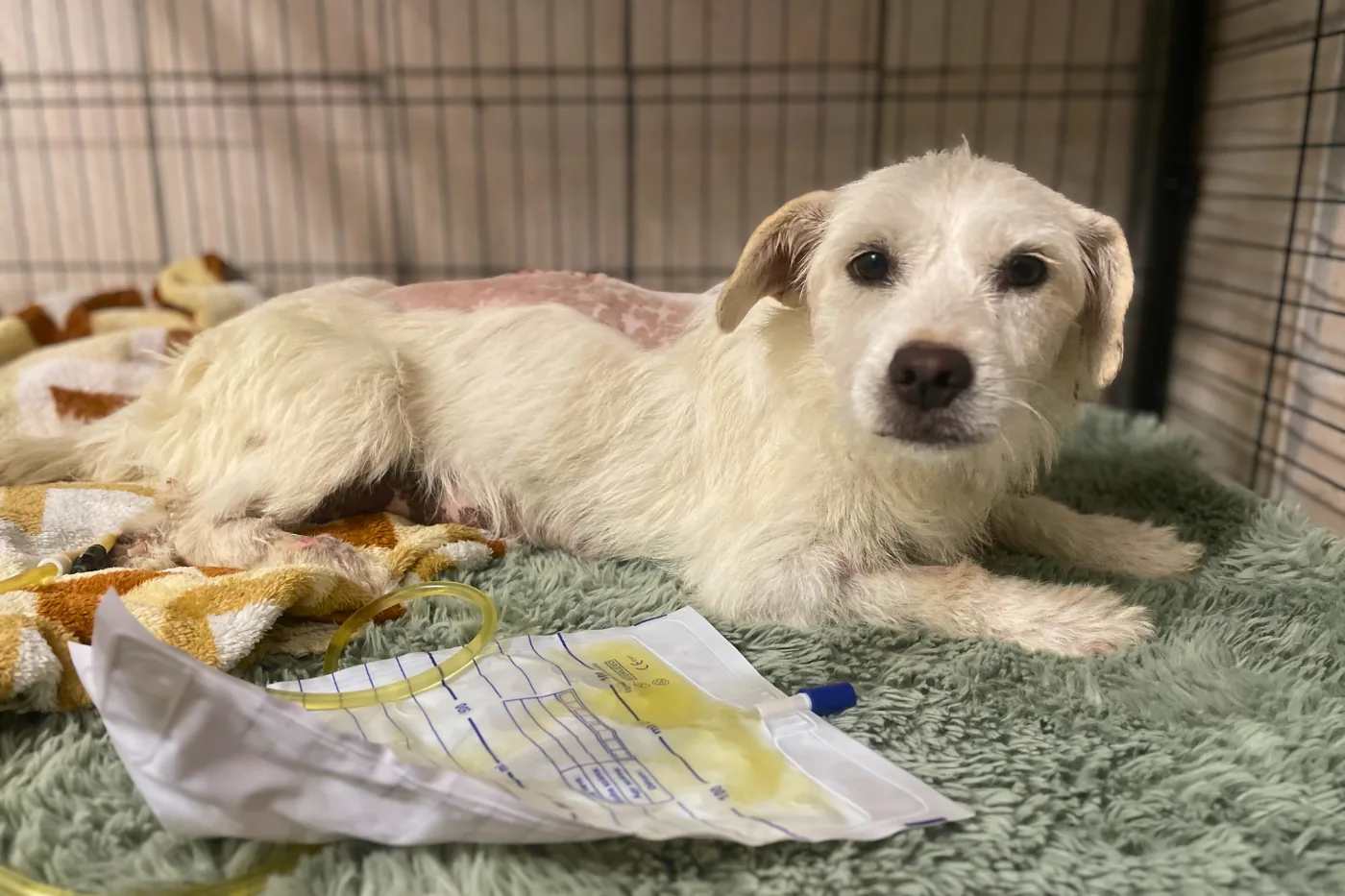
When Rafi arrived, his abdomen was noticeably swollen. He had not been able to urinate properly for days, a huge volume of urine had built up in his bladder, and he had to be catheterised. His relief was so obvious that by the time his bladder was empty he had fallen asleep on the examination table and started snoring. The bladder cannot wait.
Bowel function
This varies greatly from dog to dog. Some pass stools practically normally, in some they come out unpredictably, and some are constipated – fortunately the last is the rarer case. Diarrhoea, however, is a serious problem in a paralysed dog: the skin quickly becomes sore, and rehabilitation stalls too. Sadly we have been through this as well, and it was a nightmare – for us and for the dog.
With Miso this took almost three months. He arrived with almost unstoppable diarrhoea; meanwhile he kept his hind legs constantly tensed, and they stiffened so quickly that from one day to the next they could no longer be bent properly. He needed exercises and bandaging, but because of the diarrhoea these were exactly the things we could not do properly, and he also got his wheelchair later.
Skin and bedding
- A soft, well-padded, dry bed with easily washable layers.
- If the dog cannot turn over by itself, it has to be turned regularly. Ask how often.
- Check its skin every day, especially on the hips, elbows and hocks and around the hindquarters: redness, broken skin, weeping, odour.
- Clean and dry skin soiled with urine or faeces as soon as possible.
- Nappies can help, but the skin underneath easily becomes sore, so change them often.
Rehabilitation
The aim of rehabilitation is to support recovery, support the joints and muscles, reduce pain, and help the dog make the best possible use of what it has. The basics are simple, and they count the most: gentle passive movement of the joints, and assisted standing and walking. After surgery, with the specialist’s approval, these can be started within the first few days.
The underwater treadmill and swimming give a lot to many dogs, because the water supports their body weight and they become capable of movements they cannot yet manage on dry land. After surgery they can be started once the wound allows. Most dogs really enjoy massage. Electrical muscle stimulation should only be used in the hands of a specialist.
If the dog shows pain during an exercise – whimpers, pulls away, tenses up, snaps – stop, and discuss it with the specialist.
It is interesting how much has changed. Seven years ago, with Rafi, we were still asked to wait a month before starting physiotherapy. Today the view is that it is better to start almost immediately.
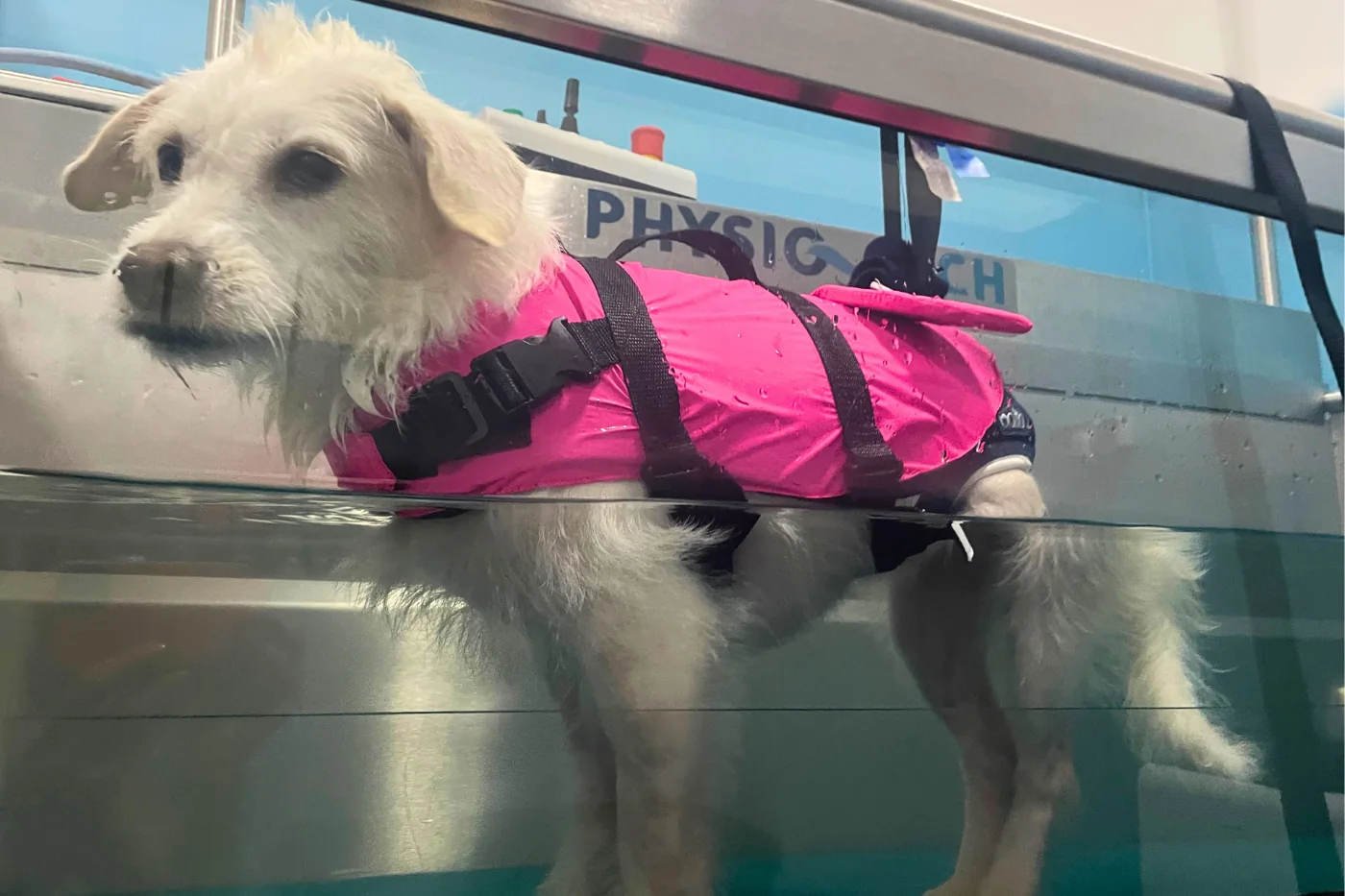
Yoda and Füge went to the dr. Hidro Small Animal Rehabilitation Centre for physiotherapy and hydrotherapy. Füge’s first encouraging signs came in the water: that is where she began to use her legs more and more actively. A dog about whom nothing good could be said on the basis of her scan reports nevertheless began, in the pool, to argue with them.
Dog wheelchair
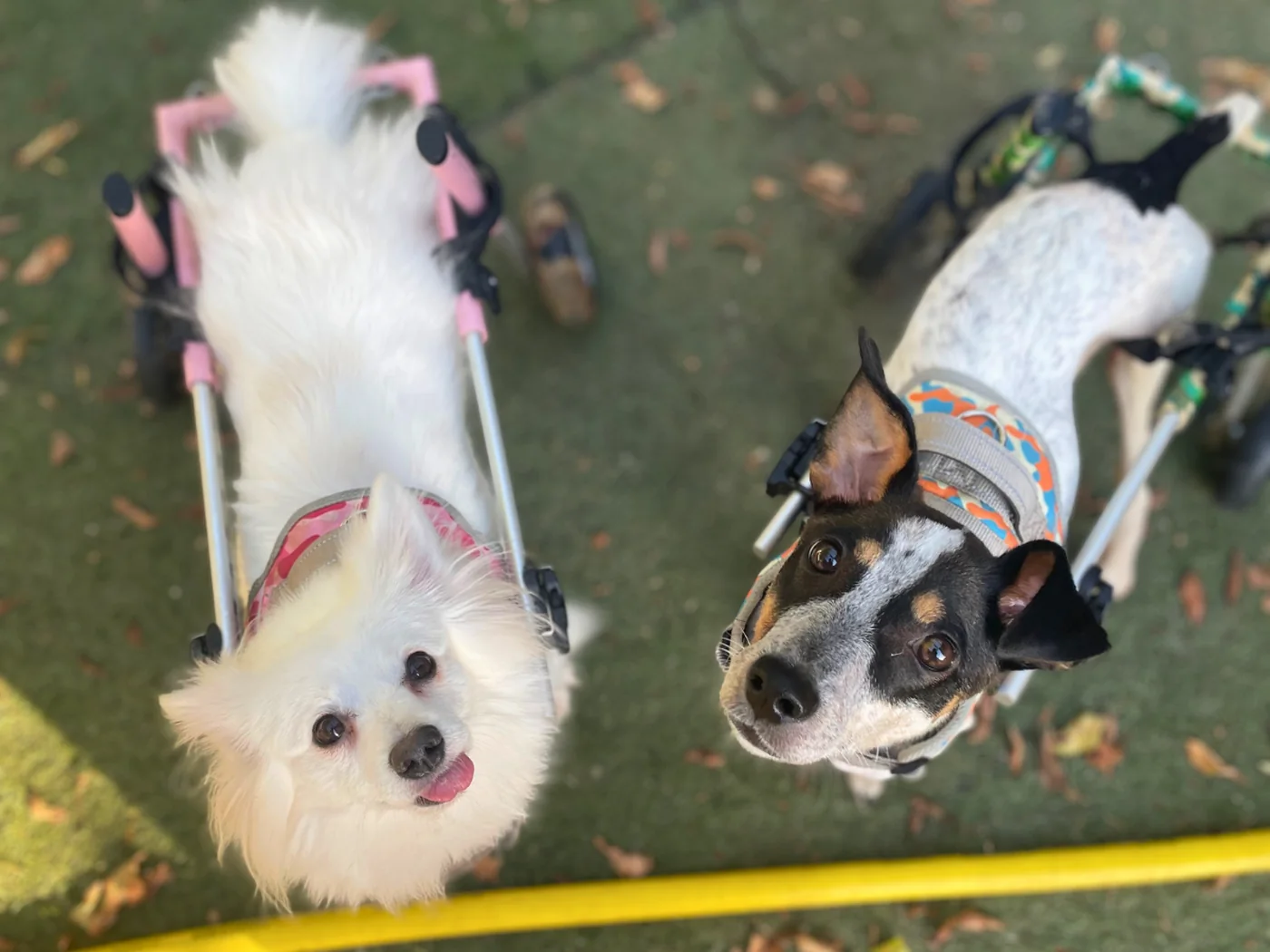
A wheelchair is not a cure: it does not heal the spinal cord, and it does not replace targeted physiotherapy. As a rehabilitation tool, however, it is very good indeed, and this is often underestimated. As soon as the dog sets off in the wheelchair, it is working: the front half carries its body, its trunk works on balance the whole time, and if it moves its hind legs, they move along with the walking too. Over a day this adds up to far more repetitions than a single exercise session.
The other thing a wheelchair gives is stimulation. Physiotherapy is not a chore – many dogs genuinely love their therapist and look forward to the sessions. But that is one room, one appointment and one set of exercises. In the wheelchair the dog is outside, follows scents, goes after the others, and decides for itself which way to go. Anyone who has seen a dog on its first lap in a wheelchair knows: laziness is not among the symptoms.
It gives something back to the owner too. With a towel, holding up the dog’s rear end, every walk is a three-handed operation, and within a few weeks the owner’s back suffers. With a wheelchair the dog goes by itself, and the owner can be an owner again, not a bottom-holder.
All this is true if the wheelchair is properly adjusted. A badly adjusted wheelchair can rub the skin raw and overload the front legs and shoulders, so it has to be adjusted by a specialist and checked from time to time. At first, use it for short periods, under supervision. The dog cannot lie down in the wheelchair, and it needs rest too. And the wheelchair is part of rehabilitation, not the end of it: targeted exercises are still needed alongside it.
Regular check-ups
- A urine test from time to time, and always if the urine changes.
- The condition of the skin, body weight, muscles and joints.
- Reassessment of pain, including in the overloaded parts of the body.
And you?
Caring for a permanently paralysed dog can last for months or years, and it has costs too: examinations, surgery, rehabilitation, equipment, nappies. It is worth talking about this openly and in advance, both with yourself and with the vet. This is not a weakness.
Saying that you cannot manage this alone does not make you a bad owner. The question is what help is available: family and friends who learn one task or another; the vet, who can simplify the routine; animal welfare organisations; and, if care at home cannot be sustained in the long term, a placement where it can be provided. A realistic plan is worth more than a promise that can no longer be kept three months from now.
11. Stories of the animals in our care
Six dogs. Six different outcomes. For none of them was the life they would have decided by what was written on the report on the first day.
Rafi
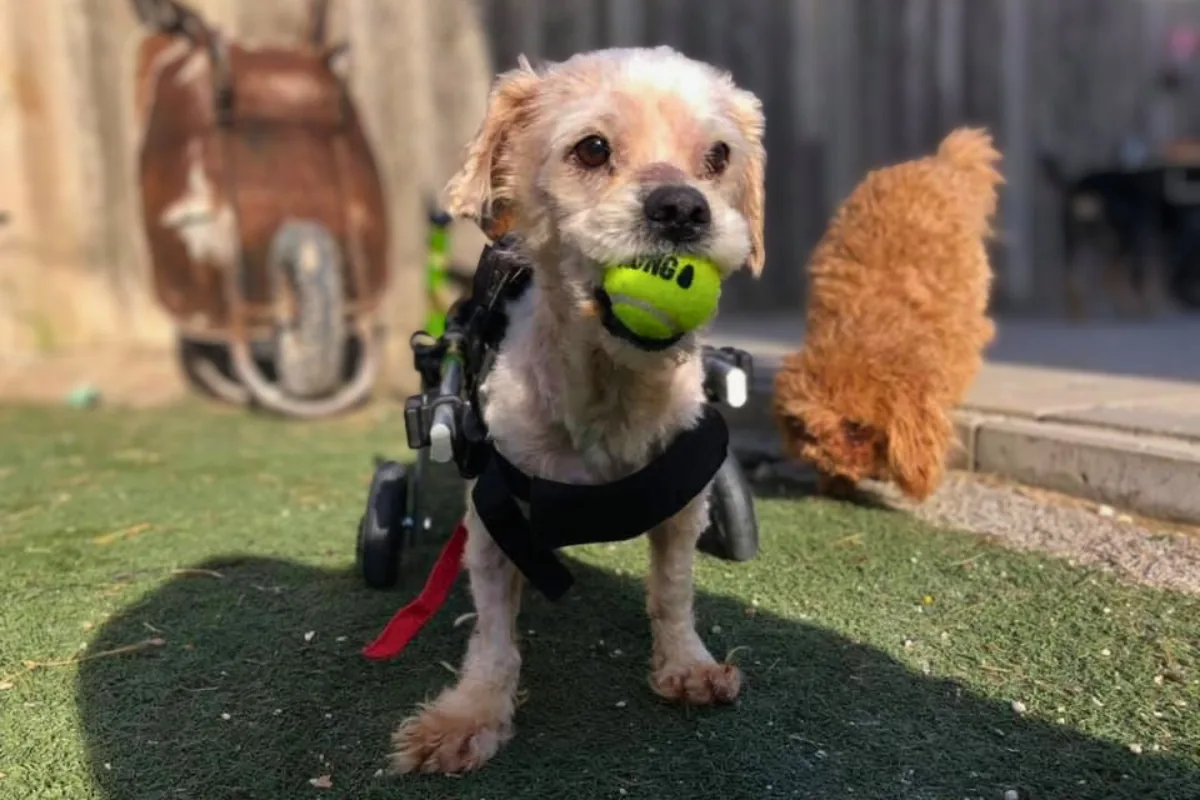
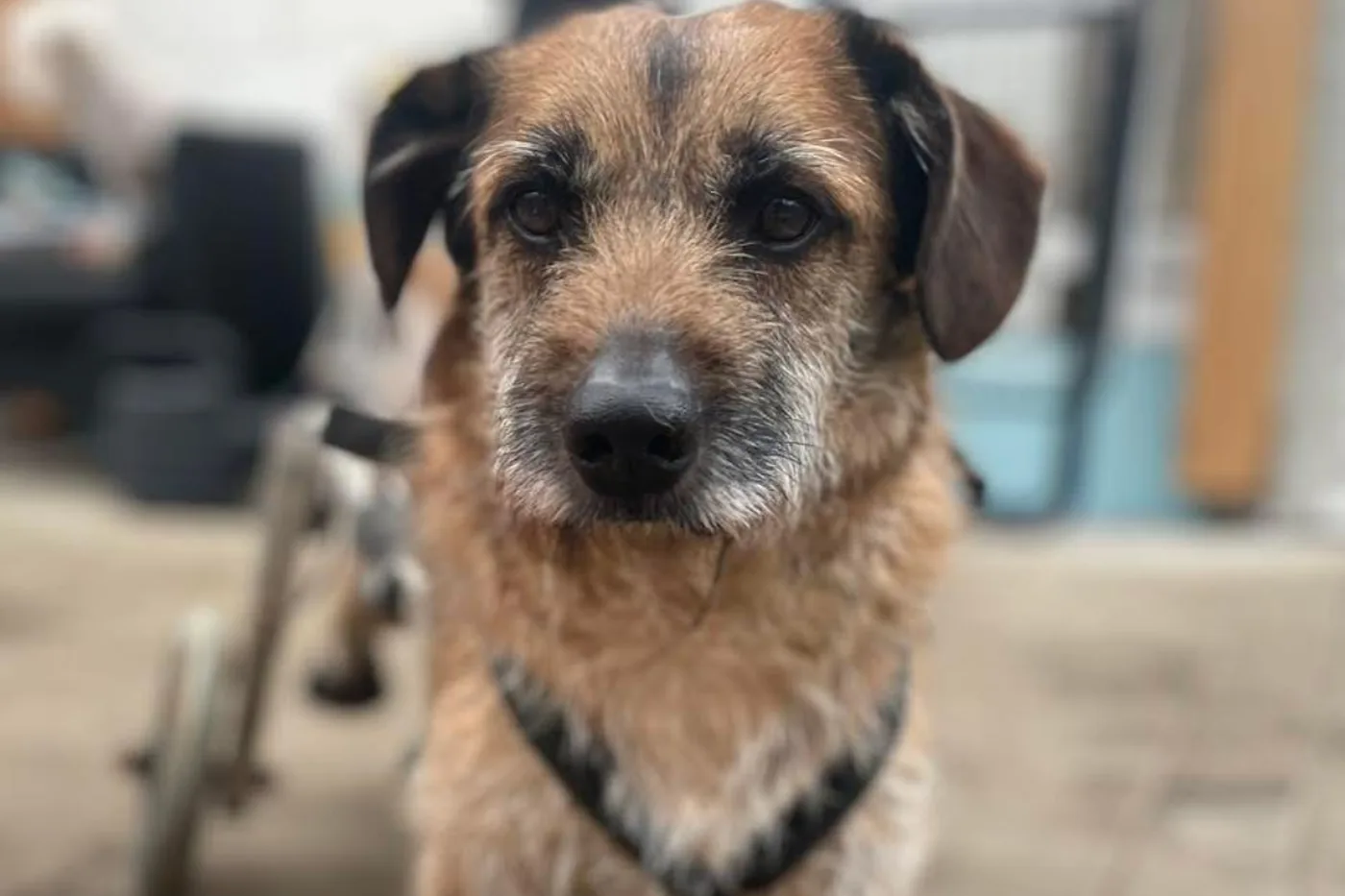
He came in March 2019 with a fractured spine. We asked for a veterinary consultation on the images, and it confirmed what we had feared: he would never walk on four legs again. His spine was stabilised at Gordiosz Klinika, and later he was given a wheelchair of his own. The honest prognosis did not take away his possibilities; it showed what was worth planning for.
On two legs and two wheels, he has been going wherever he wants for more than seven years. Strong reflex movement remained in his hind legs; he moves them constantly in the wheelchair, and his muscles have not wasted even over the years. His face is now ‘dusted with icing sugar’. You wouldn’t know it from his pace.
Yoda
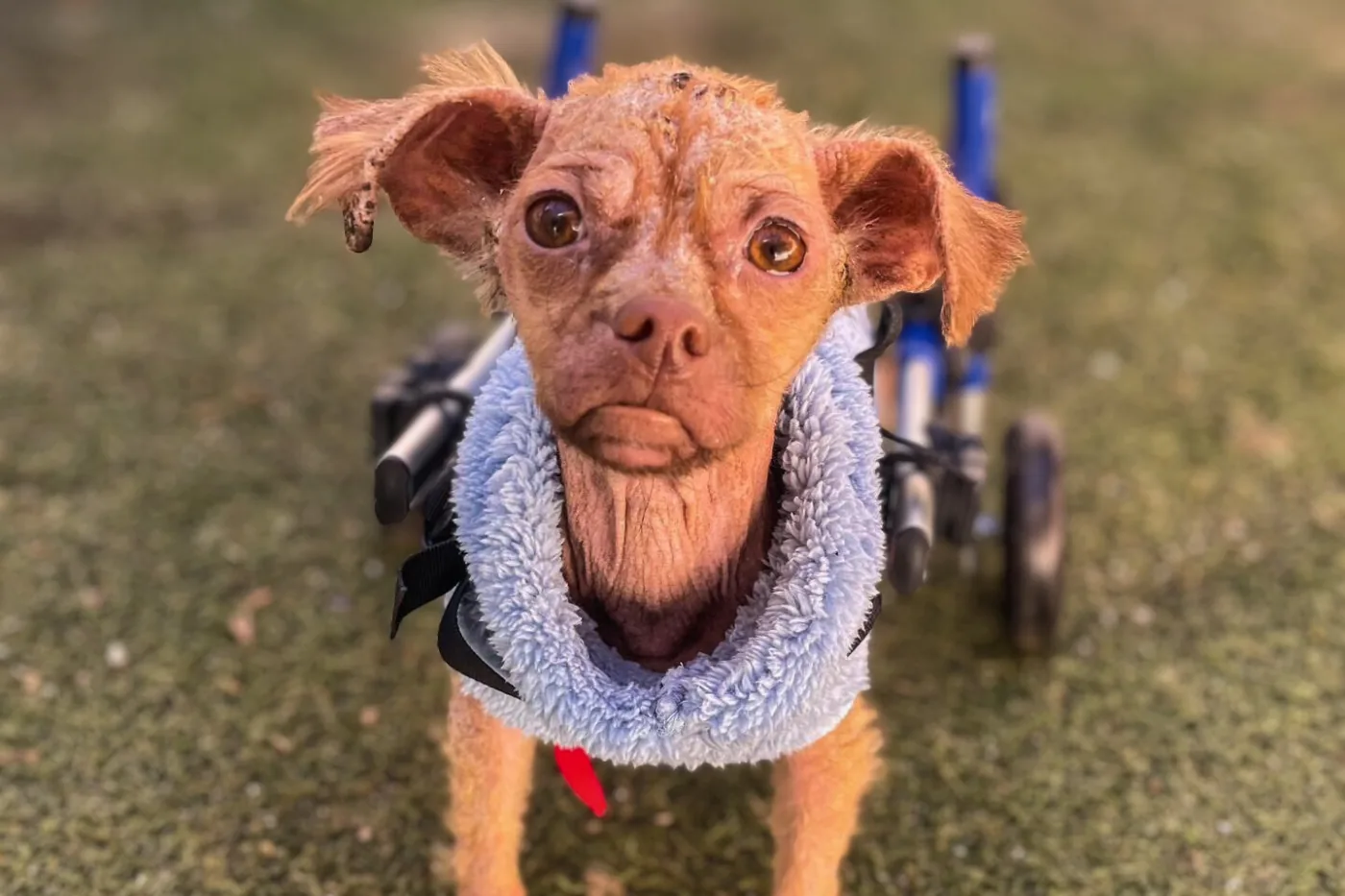
Since he was operated on that October morning, he has had physiotherapy and been given a wheelchair. In the wheelchair, which supports his body weight, he actively steps with his hind legs, and nowadays he sometimes stands up without the wheelchair and even takes a few steps on his own. His housemate is Füge, and they play like any two dogs.
Füge
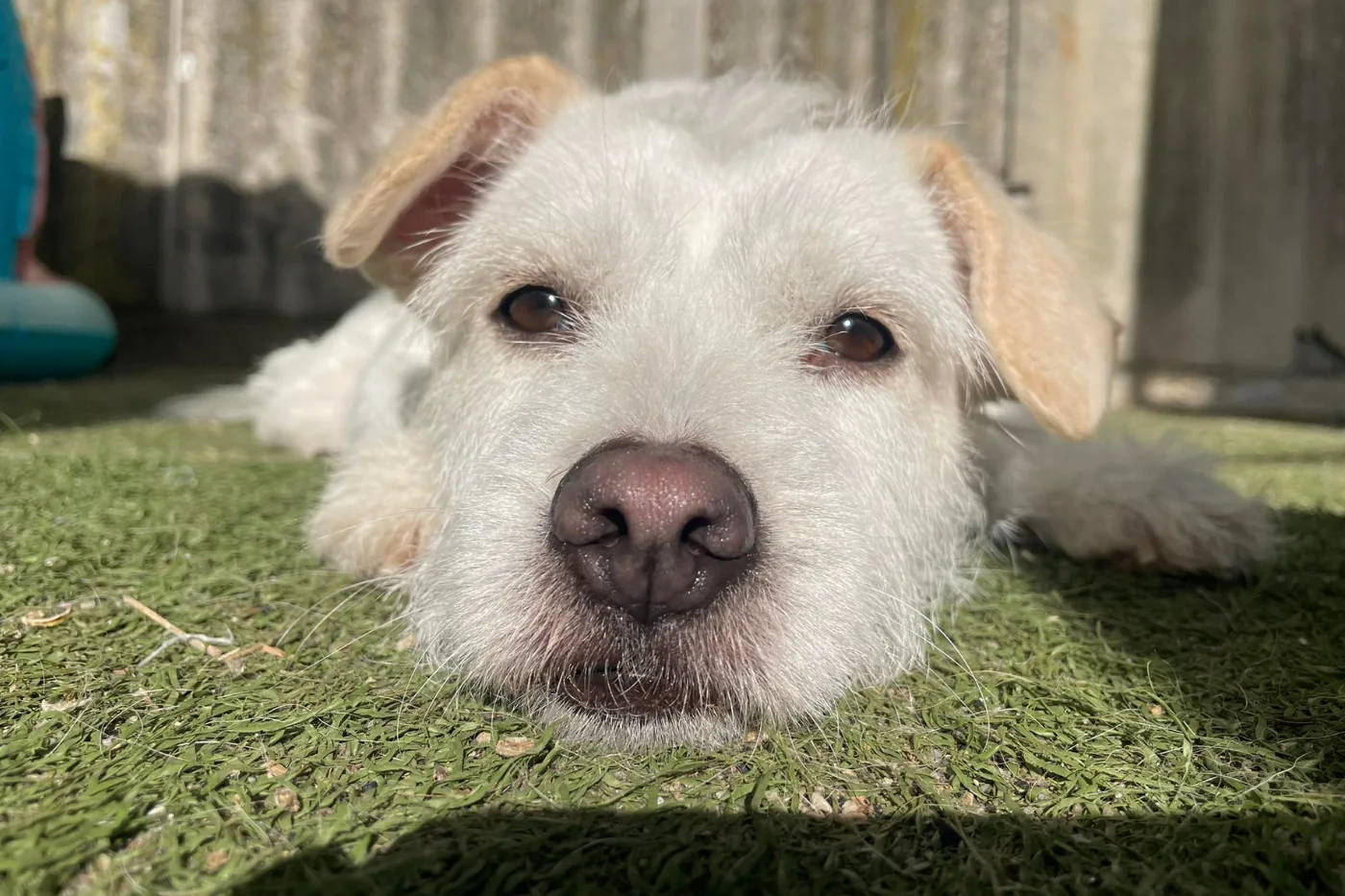
Going by her CT and MRI reports, she initially gave us the least to hold on to. She began using her legs in the water, then stood up on her own, and then ate standing up. Today she often stands up while sniffing around and tries to take steps. Her progress has not stopped since.
Miso
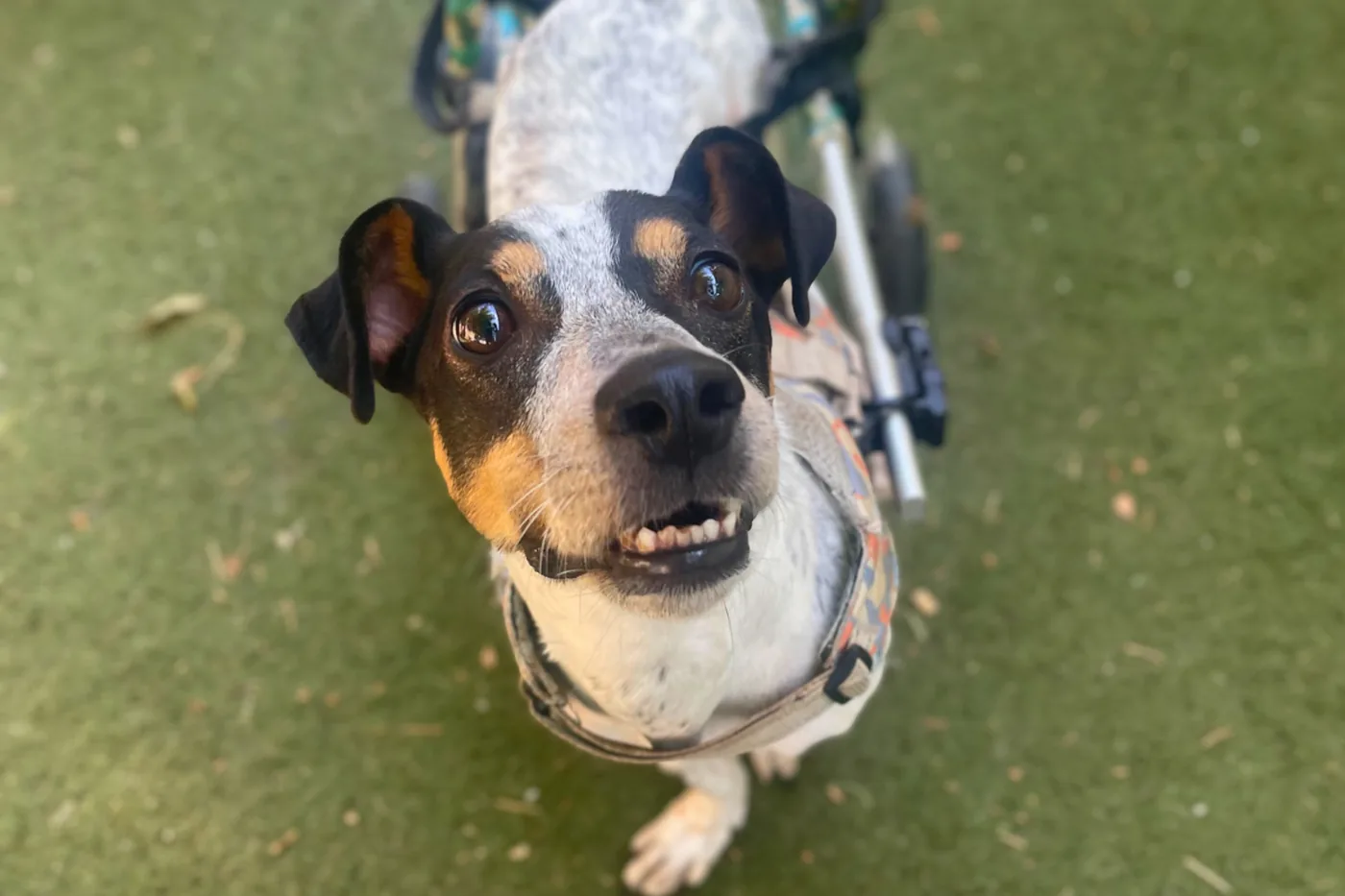
He came in February 2022 from the Puli Állatvédő Egyesület, an animal welfare association in Debrecen, having already had surgery for a spinal fracture. He had no deep pain perception and no reflex movement, and he could not hold his urine or stools. On paper, this is the worst possible starting point.
Today he is one of the most active animals in our care. He sleeps in a bed with the pack, although they have their own ideas about what a bed is for: they regularly use it as a wrestling ring. We could not make his spinal injury disappear. What we could do was help make sure it does not define his life.
Piri
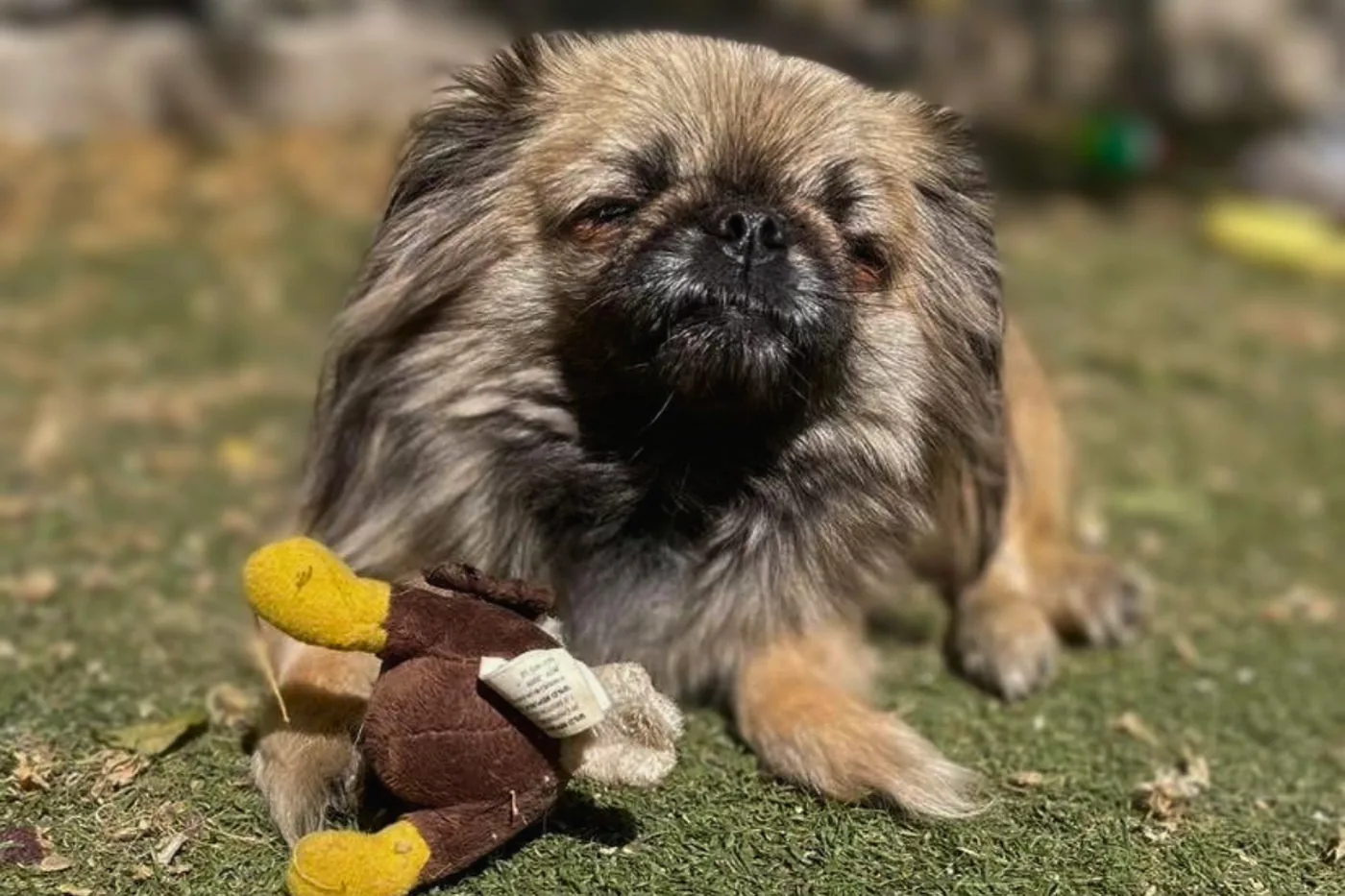
The exact cause of her condition could not be established, and it can no longer be meaningfully improved. Even so, she uses her legs, can stand up, and when something annoys her she moves surprisingly fast – she can even run. Because of this, her muscles have not wasted as much as her condition would lead us to expect. Her name comes from the English word ‘piranha’. Anyone who knows her firm opinions about people will understand why.
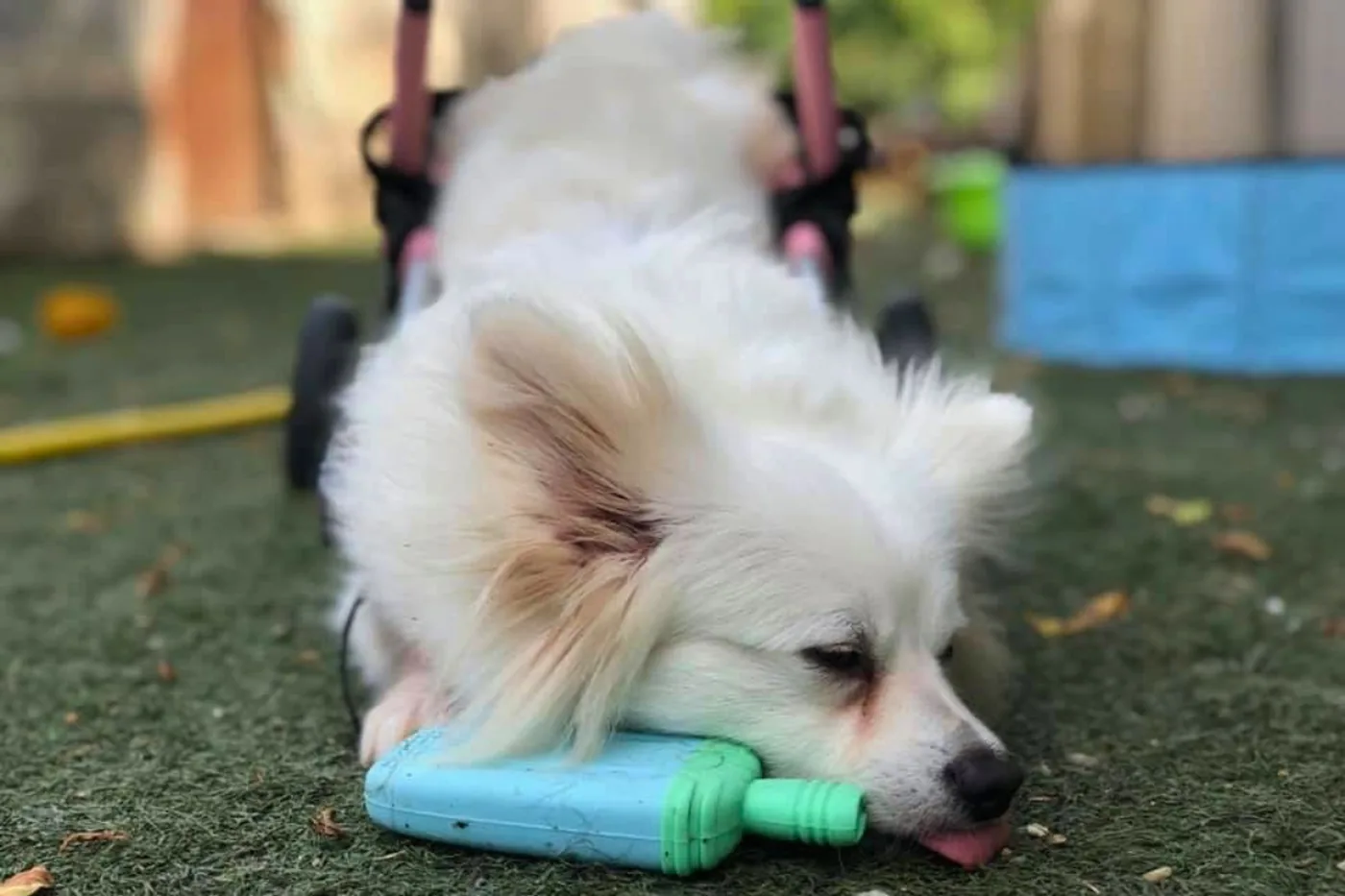
Pille
This Spitz-cross bitch came to us in March 2020, in the course of administrative proceedings, from a puppy farm in Karcag, where she had been living paralysed, shut in a rabbit cage. Her suckling puppies had been taken from her and put with another mother dog. The little ones wanted only to be with her, and she with them. In the end they were reunited, and Pille raised them.
She was an affectionate, crafty, active dog who every evening, almost ritually, demanded that we pay attention to her. Paralysis took neither her motherhood nor her opinions from her.
We keep Pille’s memory on the In memoriam page (in Hungarian); the others can be found on the Our animals page, and we have written about what a day like this looks like on the Care page.
12. What should I ask the vet?
If the shock means the questions don’t come to mind, just read them out from your phone. It isn’t rude. Nor is asking for a second opinion when serious decisions are involved.
At the first examination
- What is the most likely cause of the paralysis? What points towards it, and what against it?
- How severe is it? Does my dog move its legs, does it have deep pain perception?
- Can it pee? If not, who will empty its bladder, and how?
- Have I mentioned every medicine it has had in the last few weeks?
For the diagnosis
- Is a CT or MRI scan needed? Which one, where, how quickly?
- If surgery is needed, can it be done at the same place and straight away?
- How much do the scan and the surgery cost?
About treatment
- Is surgery an option? What can we expect from it, and what happens if we decide against it?
- Within what time frame should we decide?
- What signs indicate deterioration, and what should I do then?
- Is it getting a steroid? If so, what diagnosis is this based on, and how will it have to be stopped?
- Is it getting an NSAID? Has it previously had something this cannot be combined with?
Before going home
- Have I been shown how to empty the bladder, and have I tried it myself?
- How often does it need emptying and turning? How much movement is allowed?
- Which signs mean I should come back immediately?
- When is the check-up? Is there a rehabilitation specialist nearby?
- How long will it take to see whether it is improving?
This guide is for information only
It does not replace a veterinary examination, diagnosis and treatment plan. Every dog’s condition must be assessed individually by the treating vet. The figures refer to the patient groups of the studies cited and do not constitute a prediction for any individual dog.
- Olby NJ, Moore SA, Brisson B, et al. ACVIM consensus statement on diagnosis and management of acute canine thoracolumbar intervertebral disc extrusion. J Vet Intern Med. 2022;36(5):1570–1596. doi:10.1111/jvim.16480
- Olby NJ, da Costa RC, Levine JM, Stein VM; CANSORT-SCI. Prognostic factors in canine acute intervertebral disc disease. Front Vet Sci. 2020;7:596059. doi:10.3389/fvets.2020.596059
- Granger N, Olby NJ, Nout-Lomas YS; CANSORT-SCI. Bladder and bowel management in dogs with spinal cord injury. Front Vet Sci. 2020;7:583342. doi:10.3389/fvets.2020.583342
- Lewis MJ, Jeffery ND, Olby NJ; CANSORT-SCI. Ambulation in dogs with absent pain perception after acute thoracolumbar spinal cord injury. Front Vet Sci. 2020;7:560. doi:10.3389/fvets.2020.00560
- Rossi G, Stachel A, Lynch AM, Olby NJ. Intervertebral disc disease and aortic thromboembolism are the most common causes of acute paralysis in dogs and cats presenting to an emergency clinic. Vet Rec. 2020;187(10):e81.
- De Risio L, Platt SR. Fibrocartilaginous embolic myelopathy in small animals. Vet Clin North Am Small Anim Pract. 2010;40(5):859–869. doi:10.1016/j.cvsm.2010.05.003
- De Risio L. A review of fibrocartilaginous embolic myelopathy and different types of peracute non-compressive intervertebral disk extrusions in dogs and cats. Front Vet Sci. 2015;2:24. doi:10.3389/fvets.2015.00024
- Togawa G, Lewis MJ, Devathasan D. Outcome in paraplegic dogs with or without pain perception due to thoracolumbar fibrocartilaginous embolic myelopathy or acute non-compressive nucleus pulposus extrusion. Front Vet Sci. 2024;11:1406843. doi:10.3389/fvets.2024.1406843
- Bishop G, Cooney K, Cox S, et al. 2016 AAHA/IAAHPC End-of-Life Care Guidelines. J Am Anim Hosp Assoc. 2016;52(6):341–356. doi:10.5326/JAAHA-MS-6637
- Spitznagel MB, Jacobson DM, Cox MD, Carlson MD. Caregiver burden in owners of a sick companion animal: a cross-sectional observational study. Vet Rec. 2017;181(12):321. doi:10.1136/vr.104295