 Állatmentő Szolgálat
First a single cat turns up in the garden. Then another. And by spring there are kittens hiding by the fence. Elsewhere, cats live around the basements of housing estates, and everyone in the neighbourhood knows something about them, but nobody sees the whole picture. Some people feed them, others complain, and meanwhile more litters are born. There is no shortage of goodwill. What is in short supply is coordinated help.
That is what TNR is for: to stop free-roaming, unowned cats from breeding further, without leaving them without care. The method is not right for every cat, and a neutering here and there does not solve the problem on its own. We show how it works in practice, when another solution is needed instead, and what you can do if you find a cat on the street. Along the way, we share stories from our own rescues, because sometimes the fate of a single cat shows better than anything why it matters to make the right decision.
If you remember only one thing: the three letters of TNR stand for trapping, neutering and returning, but the work does not end with the release. In a managed colony you also have to watch for new animals, injuries and illness. And with a cat you have found, the first question is always whether it has an owner, and whether it needs urgent veterinary help.
What is TNR, and what is it for?
In TNR, a term taken from the English ‘Trap-Neuter-Return’, cats are caught with a suitable live trap and neutered by a veterinarian, and then, after treatment and recovery – if conditions allow – they go back to their familiar territory. There, someone must continue to look after them.
Trap
Trapping
With a humane live trap, planned in advance, under supervision.
Neuter
Neutering
The vet examines the cat, neuters it and, if needed, treats its injuries.
Return
Return
Once recovered, the colony cat goes back to where it was trapped, if that is safe.
The work does not end with the release: the longer part only comes afterwards – care, monitoring and neutering new cats.
Why isn’t it enough simply to take the cats away?
Some free-roaming cats are not used to people. For a truly feral adult cat, long confinement can cause severe stress, and there is no guarantee that it will ever become adoptable. The ISFM’s professional guidelines therefore emphasise weighing up the cat’s socialisation, health and living conditions (Sparkes et al., 2013). Moreover, simple removal on its own does not necessarily reduce cat numbers in the long term: as long as there is food and shelter, new animals may appear. TNR aims to stop breeding, and ongoing care is about making sure that the cats that stay do not drop out of sight.
Neutering can also benefit the individual animals. It spares females further pregnancies, and in toms it often reduces roaming, mating-related fighting and urine marking. Fewer unwanted litters are born, which means fewer kittens end up in a vulnerable situation in the first place. This does not mean that neutered cats can no longer fall ill or be injured. That is exactly why follow-up matters.
Why is it more than trapping and neutering?
A common misconception is that TNR amounts to this: we catch the cat, operate on it, and put it back where it came from. If that is all that happens, it really is too little, and it does the cats no good either. Responsible TNR is a population management process. It includes surveying the colony and keeping records of individual cats, recognising new cats and trapping intact (unneutered) cats as soon as possible. It also involves picking out sick and injured animals, considering adoption for kittens and friendly cats, keeping the feeding station in order, keeping the surroundings clean and reaching agreement with residents. None of this happens just once; it happens continuously, month after month, year after year.
Why do cat colonies form?
A cat colony forms where cats have something to eat and somewhere to hide. An unneutered cat reaches sexual maturity at around six months of age, and a female can be pregnant several times a year, so the offspring of a single pair can grow into a sizeable group within a few years. The group stays where it finds food: by the bowls put out by feeders, around restaurants and bins, on industrial sites, in empty buildings, basements, gardens and cemeteries.
Cats end up on the street in several ways. Some are abandoned or dumped pet cats. Others are the offspring of unneutered owned cats that are allowed to roam freely, and grow up on the street. A cat born outdoors that does not meet people in the first weeks of its life will very probably never become tame. Such a cat is called feral (in Hungarian, elvadult).
The terminology matters because the law and the profession see the issue differently. Hungarian legislation defines a stray animal (kóbor állat) as an individual domestic dog or domestic cat that is outside its place of keeping without the supervision of its keeper (Government Decree 785/2021 (XII. 27.), Section 2(e)). This definition does not say that the animal has no owner. The neighbour’s outdoor cat strolling across the street may also be legally ‘stray’ while being a much-loved pet. An unowned (gazdátlan) animal is one that genuinely has no owner, and the difference between the two is considerable. The international literature also uses the term community cat for free-roaming cats that residents of a neighbourhood regularly feed or keep an eye on, and professional guidelines include feral, street, community, stray and abandoned cats alike within the scope of population management.
This has a practical lesson: if you see a cat outside, you do not yet know whether it is unowned. TNR cannot replace checking whether the animal has an owner, whether it is lost, whether it needs help and whether it is suitable for adoption. We return to this in the practical section.
Not every cat belongs indoors: friendly and feral cats
The same neighbourhood may be home to a lost pet cat used to people and to an animal that has avoided people all its life. From the outside, they do not necessarily look different. But the help they need can be completely different: for one, the owner or a new home must be found; for the other, safe on-site care may be the better path. There are also cases in between, so a cat should never be permanently categorised on the basis of a single frightened reaction.
Why are friendly and feral cats different?
Kittens develop trust in people especially easily in the first weeks of life. The literature generally places the most sensitive socialisation period at 2–7 weeks of age. This does not mean that change is impossible later, but that early positive experiences are particularly important. We also write separately about caring for kittens and the options later on.
A feral cat is not a wild animal, but a domestic cat that has not been socialised to people. The English-language literature calls it feral, while ‘stray’ often means a cat that used to be accustomed to people and has become lost or been left to fend for itself. The legal meaning of the Hungarian term ‘kóbor’ (stray) differs from this, and the line is not always sharp in behaviour either. It also happens that a long-abandoned cat is unapproachable at first, but later, in safe conditions, seeks contact with people again.
How do they behave differently?
The difference shows in behaviour, not appearance: coat colour, breed or how well groomed a cat is does not reveal whether it is friendly. The signs below are for guidance only.
| Aspect | Friendly, socialised cat | Feral cat |
|---|---|---|
| Relationship with people | Often approaches you, rubs against you, seeks your attention. | Keeps its distance, runs away, does not let you come close. |
| Voice and body language | Often meows at people, but in an unfamiliar place may also be quiet and frightened. | Mostly avoids direct contact with people; may also vocalise out of fear. |
| Touch | Relaxes and lets itself be stroked. | Does not want to be stroked, and remains fearful even when fed regularly. |
| In a trap or at a shelter | May be stressed or defensive; often relaxes over time once it feels safe. | May remain fearful for a long time and may not tolerate being approached. |
| Social life | May live alone or near several cats. This alone is not a decisive sign. | May be a colony member or live alone. |
| Indoors | With proper settling in, can live well alongside people. | Long confinement can be a significant stress; each case needs individual assessment. |
These are indicative signs, not definitive diagnoses. A friendly cat may also hiss and flee if it is afraid, in pain or trapped. And a cat living in a colony may trust its familiar caretaker while still keeping its distance from strangers. Deciding takes time, observation and often an experienced professional.
Where does each cat belong, and why?
The question is not which cat is better, but where each one can have the best life.
| Cat | Where it belongs | Why |
|---|---|---|
| Owned, socialised pet cat | At home, with its owner. It can spend time outdoors in an escape-proof cat enclosure, a cat-proof garden or a properly netted balcony. | On the street it is at risk from cars, disease and abuse. A microchip and vaccinations are important, but they do not replace escape-proof keeping. |
| Friendly, lost or abandoned cat | First, a search for the owner; if there is none, a new home. | It is used to people, so it can also live well in a new home. |
| Kitten that can be socialised | Foster care, then adoption. | At this stage of life it is easiest to accustom to people; later it becomes increasingly difficult. |
| Feral adult cat | In its familiar territory, neutered, documented and regularly cared for (TNR). | Confinement is unacceptable stress for it, whereas its familiar territory and companions give it security. |
| Shy, partly socialised cat | Individual assessment, ideally with an experienced professional. | The level of trust can change; forced taming is not the goal. |
| Sick, injured or elderly cat | First the vet, then a place suited to its condition. | Treatment and an assessment of its condition come first; only then can it be decided whether it is fit for life outdoors. |
| Feral cat in a dangerous place | Planned relocation involving an organisation, as a last resort. | In the case of demolition, traffic or abuse, return is not a solution, and relocation requires weeks of settling in. |
‘But it was born free’: why is this not an argument for an owned cat?
‘Born free’ – this is how many owners explain why their cat may go out unsupervised. The wish is understandable: cats like to look around, sniff and explore. But curiosity does not protect them from traffic, poisoning or a dog attack. The risk of going outdoors is borne not by the owner but by the cat.
For an indoor cat attached to people, safety is not a punishment. The situation of a feral colony cat is different: it finds its way confidently in its familiar territory and may cope poorly with prolonged confinement. It is not worth forcing the same answer on every cat.
Free roaming carries several dangers: road accidents, injury, poisoning, going missing, infection. Feline immunodeficiency virus (FIV) is mainly spread through deep bites, so toms that fight are particularly at risk. Feline leukaemia virus (FeLV), by contrast, can also be transmitted through close contact, for example mutual grooming or sharing a food bowl. So the two infections do not spread in the same way (Cornell Feline Health Center).
Keeping a cat safely does not mean that it sits in an empty room all day. It needs exercise, high places, hiding places, play and the chance to keep in contact with us in its own way. If it wants to be outdoors, there is a solution for that too: an escape-proof cat enclosure, a cat-proof fenced garden or a balcony closed off with suitable netting. This way it can enjoy the fresh air and sunshine without ending up on the street.
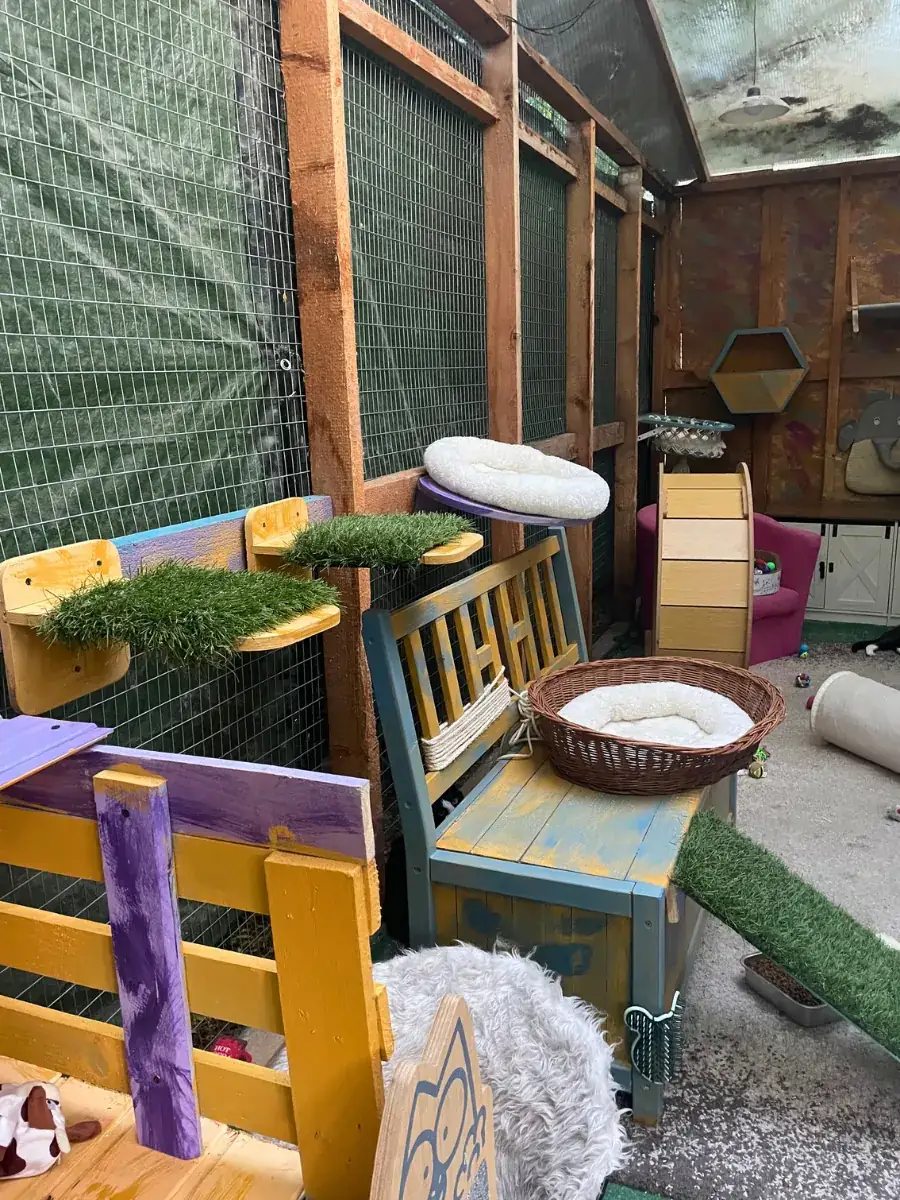
Neutering, a microchip and the vaccinations recommended by the vet are part of responsible care, but they do not make unsupervised outdoor access safe. A chip can help get a lost cat home, but it does not protect it from cars; vaccination does not prevent poisoning or abuse either. The task is not to try to mitigate the consequences of roaming after the event, but to create a safe living space for the cat in the first place. Regardless of this, neutering is essential: the offspring of unneutered, free-roaming owned cats also add to the number of cats living on the street.
There can also be legal consequences. Under Act XXVIII of 1998 on the Protection and Humane Treatment of Animals (the Animal Protection Act, Ávtv.), the keeper must ensure that the animal is housed appropriately and safely, cared for properly and prevented from escaping (Section 5(1) of the Ávtv.). Some local government decrees are more specific: they may require that the animal’s living space be provided within the property where possible and that, where there is a risk of straying, the animal be given an identification mark (for example, Decree 9/2015 (IV. 29.) of the Martonvásár local government). Under the government decree, a cat found unsupervised outside its place of keeping may qualify as a stray animal, and if its owner is not found within 15 days, it becomes the property of the State (Government Decree 785/2021 (XII. 27.), Section 2; Section 48/A(3) of the Ávtv.; Government Decree 785/2021 (XII. 27.), Section 11(3) and (4)). The owner of an unmarked cat is often hard to find. In Hungary, microchipping cats is generally not compulsory. The exception is when a captured stray cat is adopted: in that case it must be marked with a microchip (Government Decree 785/2021, Section 14(1)).
So the question is not whether the cat likes being outside. It is how to give it the chance to explore without paying for it with its life.
Why is taking a feral cat home not a solution?
If a cat is hungry or cold, it is natural to want to take it home. With a friendly cat that previously had an owner, this is often a good starting point. A truly feral adult cat, however, may panic in an enclosed, unfamiliar space. It hides, tries to escape, does not eat, and defends itself if we try to touch it. The question is not whether we are able to keep it indoors, but whether doing so improves its life.
At the same time, return is not automatic either. If the cat is injured, needs long-term treatment, or its territory is dangerous, another solution must be found. A protected enclosure, veterinary care or individual care may also be justified. The point is not to put every animal in the same place, but to base the decision on the safety and welfare of the individual cat.
Some cats need a new owner. Some need a calm, regularly cared-for outdoor habitat. And some fit into none of the simple categories.
How does TNR work in practice?
Responsible TNR consists of seven steps: scouting and colony survey, trapping, veterinary care and neutering, documenting the animals so that they can be identified, post-operative observation, return to the original territory, and finally regular care and follow-up. The marking method and its legal conditions must be examined separately for each country; record-keeping and follow-up, however, are essential in every programme.
- SurveyCounting, photos, coordination.
- TrappingHumane live trap.
- NeuteringExamination, surgery, wound care.
- RecordsPhoto, description, veterinary data.
- ObservationSupervised recovery, vet’s clearance.
- ReturnBack to where it was trapped, if that is safe.
- CareFeeding, monitoring, new cats.
A new cat arrives: back to trapping.
Scouting and colony survey
Before you trap a cat, just watch for a few days. Go out at the usual feeding time, count the animals, and note down or photograph their colours, distinctive markings, visible injuries and any identification. It is also worth recording ear-tipping, known from international TNR practice, but neither its absence nor a damaged ear decides on its own whether the animal is neutered. Check whether there are kittens, pregnant or nursing females or sick animals. Also find out who feeds them, and who owns the site.
This matters because TNR only works if as large a proportion of the colony as possible is neutered. For that, you need to know how many cats are involved, and how many traps, surgery slots and days will be needed. The survey also shows which cats are already neutered and which do not belong to the colony: the latter may be someone’s straying pet. You also need to coordinate with the people in the area, especially the feeders, so that they know when the trapping will take place and do not feed the cats until then.
Trapping
To trap wary cats, a suitable humane live trap is usually used. The door closes when the animal steps in after the food. A well-chosen trap used properly reduces the risk of injury, but trapping can still be stressful, so it requires preparation, constant supervision and experience. In special situations, experienced trappers may also use other equipment, such as a drop trap.
Trapping must always be planned together with the veterinary appointment and post-operative housing. It is worth getting the cats used to being fed at the same place and time in advance, and coordinating with the other feeders in the area. Several TNR guides recommend withholding food for about 24 hours before trapping, but this is not a general rule for anaesthesia: it can be dangerous for kittens and for nursing, sick or weakened animals. The timing must be agreed with the professional leading the trapping and with the veterinarian. Fresh drinking water should always be available.
The trap must be placed in the usual spot, on a stable surface, positioned so that the trapper can watch it continuously. Once the door has closed, the cat will usually be calmer if the trap is covered properly, with ventilation ensured. In heat or cold, the animal must be moved to a safe place at a suitable temperature as soon as possible. Never leave a set trap unattended.
A frightened cat bites and scratches, so do not reach into the trap or hold your hand near its door. If you are doing this for the first time, do not go out alone: ask an experienced helper, or leave the trapping to an organisation that does it regularly.
Veterinary care and neutering
The trapped cat is handed over to a veterinarian, who examines it, checks for a microchip and any information pointing to an owner, and then, after the necessary preparation, performs the neutering and treats any injuries. The vet decides on vaccinations and parasite treatment based on the animal’s condition and the applicable rules. In Hungary, rabies vaccination of cats is not generally compulsory, but there are exceptions: for example, under Section 5(6) of Decree 164/2008 (XII. 20.) FVM of the Minister of Agriculture and Rural Development, a carnivorous mammal captured as part of the municipal duty to capture stray animals that has not bitten a person may only be released after a certified rabies vaccination no more than one year old. This does not mean that the same procedure applies to all TNR trapping by civil society organisations and volunteers.
Only a veterinarian may perform the operation, as it requires anaesthesia, pain relief and surgical skills. Neutering is an express exception to the rule prohibiting surgical procedures that alter an animal’s appearance or otherwise do not serve its health (Section 10(2) of the Ávtv.).
Identification and documentation: international ear-marking and the microchip
How do we know that we are seeing the same cat, and whether it has already undergone a procedure? In good records, each animal has a photo, a description and veterinary data. Some TNR programmes abroad also use a clearly visible ear mark so that an already neutered cat is not needlessly trapped again. A visible mark, however, does not on its own replace record-keeping.
An internationally known method is ear-tipping, or in some programmes ear-notching. According to the ISFM’s professional guidelines and several TNR protocols abroad, ear-tipping is performed under the same anaesthetic as neutering, in veterinary conditions. A tipped ear can be recognised from a distance, so it can help identify neutered colony members without having to trap them again. This does not mean that the procedure is automatically permitted in Hungary.
A microchip serves a different kind of identification: it provides a unique identification number, but can only be checked with a scanner. That is why photo identification of individual cats, veterinary records and colony records are particularly important. On free-roaming cats a collar can get caught or fall off, so on its own it is not a reliable solution.
The legal situation in Hungary must be kept separate from international practice. Hungarian law does not regulate this question. Section 10(2) of the Ávtv. restricts, as a general rule, surgical procedures that are not carried out for health purposes, and subsection (3) requires that the least painful solution be used when marking an animal, but neither says anything about the best-known marking method of TNR programmes. This is a legal gap, so we do not present the method as an accepted procedure in Hungary.
Article 18(3) of Regulation (EU) 2026/1818 of the European Parliament and of the Council, however, now expressly addresses this: it provides that, by way of derogation, Member States may allow ear cropping by notching or tipping cat ears in the context of marking stray cats when neutered under a ‘trap-neuter-return’ programme. The emphasis is on the wording ‘Member States may allow’. The EU provision does not itself grant a general permission in Hungary, nor does it make ear-marking compulsory. Article 18 of the Regulation applies from 31 August 2028 (Article 33). The Hungarian legislator should therefore clearly regulate under what conditions, and with what professional oversight, the method may be used. Until then, the choice of marking method cannot be regarded as a merely technical matter: the veterinary and legal conditions must be clarified in advance.
Post-operative observation
After surgery, the cat may only go back once it has woken up safely, its condition is stable and the vet gives permission. Until then it must be observed in a quiet, protected place at a suitable temperature. International guidelines typically mention 24–72 hours, but sex, the procedure and the individual animal’s condition may change this; with a nursing mother, a coordinated decision is especially important. In the event of bleeding, breathing difficulties or prolonged lethargy, a vet is needed immediately.
This is necessary because outdoors nobody notices if the cat does not eat, is bleeding or recovers badly from the anaesthetic, whereas during observation a complication can still be treated. The other consideration is that confinement is stressful for a free-roaming cat, so it should be held only for as long as the surgery and recovery require.
Return to the original territory
A recovered adult colony cat that is fit to be returned must be taken back to where it was trapped. It knows the hiding places, feeding points, dangers and other cats there. In unfamiliar territory it may get lost or try to make its way back to its old place. For kittens and friendly cats, however, adoption, the search for an owner and consideration of the individual situation always come first.
On release, we open the trap door, step back and let the cat leave of its own accord. Water and food are waiting, and the usual care continues. It is worth informing the feeders and neighbours in advance so that they know the animal has returned. The cats can also be followed using photos and the records kept; you should not assume that every one of them carries a visible mark.
If the original site has become dangerous – for example because of construction, demolition or repeated abuse – relocation may be considered. But this does not mean releasing the cat in another street. It requires a suitable caretaker, a lasting food source, safe housing and a long, supervised settling-in period. Such a decision is best made together with an experienced organisation.
Why return does not amount to animal abandonment is discussed in detail by Dr Cecília Kajó in her study (in Hungarian).
Care and follow-up
The work does not end with the return; the longer part only comes afterwards: regular feeding, monitoring the colony, recognising and neutering new cats, and taking out animals that fall ill. We discuss this in detail in the section ‘What does responsible colony care involve?’
Does every cat have to be returned?
No. Return mainly comes into consideration for unowned adult cats not socialised to people that are healthy or have been properly treated, and whose territory is suitable for safe, long-term care. In other cases, a different solution may be the right one.
An owned or lost cat does not belong in TNR. If it has a chip, or anything suggests that it belongs to someone, the owner must be sought first (we write about this in the section ‘I found a stray cat’). If it turns out to have an owner, it must be returned to them. A straying pet cat must not be neutered as a colony cat and left outside.
With a lost or abandoned cat that is used to people, you must start by looking for the owner; if it has none, it has a good chance of finding a new home. For young kittens that can be socialised, foster care and adoption are also important options. Shyness alone does not prove that an adult cat would never accept human closeness.
A sick or injured cat must first be treated by a vet. If, after recovery, it is fit for life outdoors, it can be returned. If its suffering cannot be relieved, the vet may recommend humane euthanasia, which the ISFM also regards as a legitimate option that serves the cat’s interests (Sparkes et al., 2013).
A cat living in a dangerous or unsuitable place must not be returned automatically either. In a building due for demolition, or where there is repeated abuse, the original territory is not safe. In habitats that are sensitive from a nature conservation point of view, protecting wildlife is particularly important too: hunting by domestic cats can put significant pressure on local wildlife. In such cases, a suitable solution must be sought together with animal welfare and nature conservation professionals.
What should happen to kittens?
A kitten’s fate depends on its age and on whether its mother is with it.
Kittens younger than eight weeks should generally not be taken from their mother, as the mother cat is their best carer. The Government Decree on the keeping of pet animals also provides that kittens must be kept with their mother until they are eight weeks old (Government Decree 41/2010 (II. 26.), Section 14(15)). This is a rule for animal keepers, but it follows the same principle as professional practice.
- 0–8 weeks: If the mother is nearby and healthy, the kitten is best off with her.
- 2–7 weeks: usually the most sensitive period for building trust.
- Later, progress is still possible, but it takes more time, patience and experience.
The age limits are a guide: the kitten’s health, behaviour and previous experience with people also count.
If the kittens are alone, first watch from a distance to see whether the mother comes back. She may have just gone for food, or may not dare to come out while a person is standing by the nest. The waiting time, however, cannot automatically be 12–24 hours: age, weather and the kittens’ condition all matter. With cold, lethargic, injured or conspicuously crying newborns, seek veterinary help immediately. With kittens that are safe, warm and calm, it may be justified to watch for the mother’s return from a hidden spot for a while.
If the mother is caring for the kittens, provide her with a quiet shelter and food, and arrange the later neutering; the vet always decides on its timing.
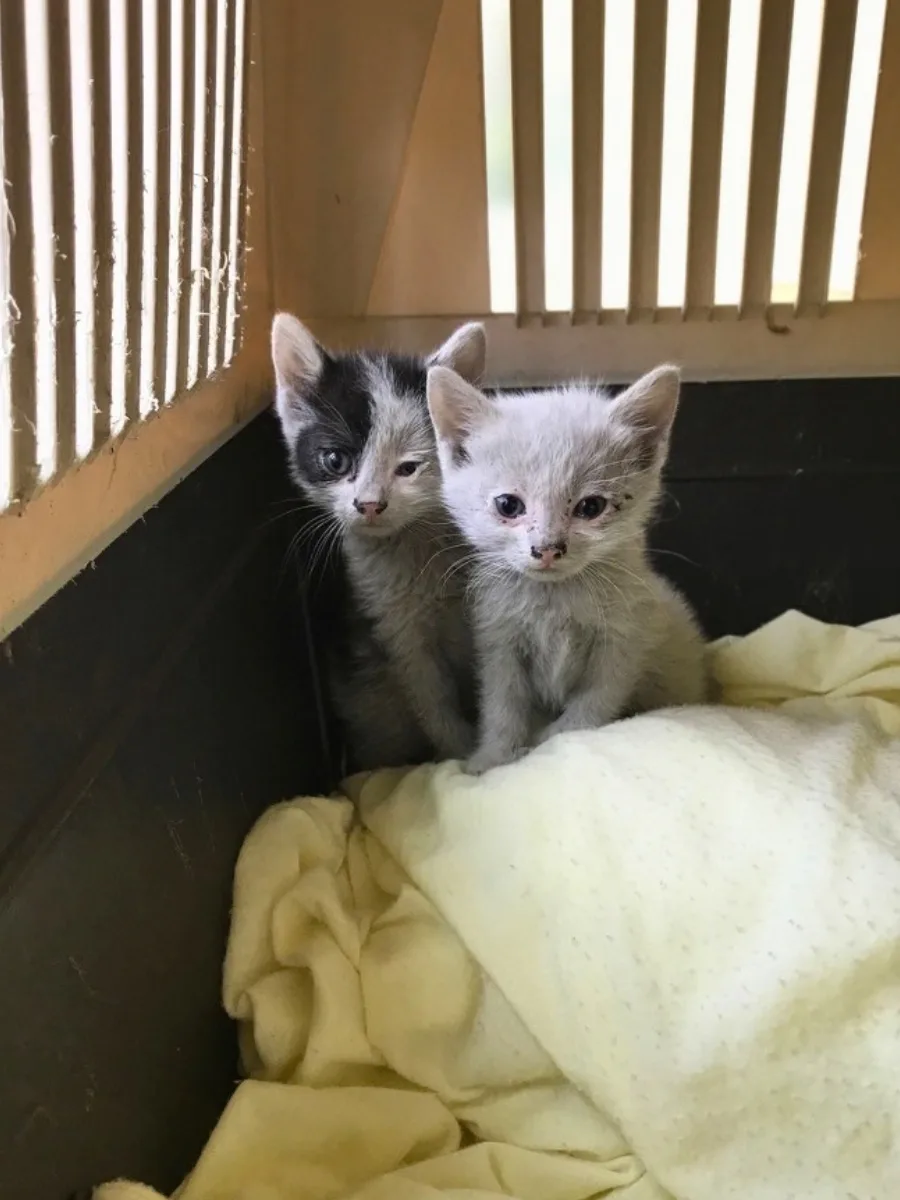
The most sensitive phase of socialisation is when kittens are 2–7 weeks old. Progress is possible later too, but it usually takes more time, patience and experience. So it is not worth deciding a kitten’s chances on the basis of a rigid age limit: its behaviour, health and previous contact with people all matter, as does whether a safe foster home is available. Do not release a kitten being prepared for adoption simply because it used to live on the street.
Caring for very young, helpless kittens whose eyes are still closed requires special knowledge, frequent night feeds and keeping them warm. Do not take this on alone: ask a vet or an organisation that works with newborn kittens for help immediately.
Why isn’t it enough to neuter a few cats once?
A colony is not a closed system. If a few cats are neutered, the others go on breeding, and new animals may also arrive from the surrounding area. Neutering can be effective in the long term if it covers many cats, if newly appearing individuals are also dealt with, and if the site is monitored for years.
In the Israeli city of Rishon LeZion, the method was studied over twelve years, in three four-year phases (Gunther et al., 2022). In the first there was no intervention, in the second neutering was carried out in half of the city’s neighbourhoods, and in the third across the whole city. Cat numbers rose during the first two phases and did not fall even in the neighbourhoods neutered at high intensity, probably because of cats moving in from the surrounding area. When the proportion of neutered cats across the whole city rose above 70 per cent, the population began to decline, by roughly 7 per cent a year. The decline was slowed by the remaining cats raising more kittens and living longer. The authors conclude that TNR must be carried out continuously, at high intensity and over a contiguous area for the population to decline in the long term.
In the United States, on the campus of the University of Central Florida, cats were trapped and neutered between 1991 and 2002, and then returned or adopted. The population fell from 68 to 23 in 11 years, a reduction of 66 per cent; 47 per cent of the cats were adopted, and newcomers were neutered or adopted before they could breed (Levy et al., 2003). In the 28-year continuation of the programme, cat numbers fell by 85 per cent between 1996 and 2019, and 11 of the 16 colonies ceased to exist. According to the authors, this is the result of the continuous care of the colonies (Spehar and Wolf, 2019).
Both examples point to the same thing: lasting results require several things together. A high neutering rate is needed; in the city studied, the trend turned above 70 per cent. Consistent follow-up is needed, so that new individuals are quickly recognised and neutered. The adoption of friendly cats and kittens is also part of it, as is someone managing the colony over many years. A stable cat population requires continuous TNR and population management.
These results were achieved in well-defined areas, with great effort. In open environments, where new cats keep arriving, the work is slower and harder, and abandoned cats also bring new individuals into colonies, so responsible cat ownership is part of the solution alongside neutering. TNR is therefore not a quick fix: results show over years, and they are not guaranteed. The data do suggest, however, that regular, consistent work can reduce cat numbers and suffering, whereas half-measures cannot.
What does responsible colony care involve?
Care is what turns TNR from a one-off campaign into a process. As the ASPCA puts it, the caretaker feeds the cats regularly, provides them with adequate shelter, monitors their health and immediately arranges for any newly arrived cats to be neutered (ASPCA, Feral Cat Sterilization Guidelines). In practice, this involves several tasks.
Feeding
Always feed at the same place and at the same time. This way the cats get food on a predictable routine, and you can see exactly how many there are and who is missing. Serve the food in a bowl, and collect whatever the cats have not eaten together with the bowl, especially in summer, when wet food spoils quickly (according to the guide of the Magyar Macskavédő Alapítvány [Hungarian Cat Protection Foundation]). Always provide fresh water. Feeding without neutering only means that the well-fed colony breeds faster, so the two go hand in hand.
Shelter and health
In winter, a dry, insulated, safe shelter is needed. The caretaker should also watch for any cat that does not turn up at feeding time, limps, loses weight, has discharge from its eyes or nose, or has a wound. It is not enough to support a sick animal with more food: its trapping and veterinary treatment must be arranged.
New cats and numbers
Take a photo of any newly appearing cat, and try to find out whether people in the area know it. If you see a mark on its ear resembling the marking known from international TNR programmes, you can record that too, but do not treat it as proof: an injury can cause a similar change. Nor does the absence of a mark mean that the cat is unneutered. Observations, the owner search and veterinary data are best kept together. Note down who has disappeared and whose behaviour has changed.
Neighbours and conflicts
Neighbours mostly object to litter, smell, noise or the location of the feeding station. The caretaker has a role here too: the bowls must be collected and the waste taken away, and the feeding station is best set up in agreement with residents, preferably away from shared entrances and play areas. Noise and marking related to mating usually decrease after neutering. Keeping people regularly informed can prevent a great deal of tension.
Is it allowed to feed stray cats?
There is no national feeding ban covering every situation. In 2017 (Köf.5.026/2017/3.) the Curia (Kúria), Hungary’s supreme court, annulled points (a) and (b) of Section 8 of Decree 17/2015 (V. 29.) of the Local Government of Budapest District IV (Újpest). One important consideration in the decision was that feeding cannot automatically be equated with any pollution it may cause. However, this decision does not mean an unlimited right to feed that is the same at every location. Public cleanliness rules, property owners’ rights and local rules, as well as the people living in the area, must always be taken into account.
The Act also defines as a keeper anyone who cares for or supervises an animal (Section 3, point 1 of the Ávtv.), so a regular feeder may also bear responsibility. This is another reason why it is better to care for a colony together with an organisation than to take it on alone.
Why do records matter, and what does the TNR Register have to do with it?
A single colony is still easy to keep track of in your head. Several sites, many cats and several years of changes are not. Success requires not only neutering many animals at one point, but also being able later to say how many animals live there, which ones are new arrivals and who needs help.
Usable records include the cat’s identifier (name or number, photo and distinctive features), the site, its sex and estimated age, the date of neutering, the veterinarian and the clinic, any microchip or other verifiable identifier, vaccinations and health problems, the dates of trapping and return, and the caretaker. They also record when a new cat arrives or one disappears. This way the records do not depend on whether a visible mark has been used.
In many places, all this lives in separate spreadsheets, message threads and photo folders. If the caretaker falls ill or hands over the task, important details are easily lost.
That is why the Állatmentő Szolgálat Foundation is developing the TNR Register. According to the plans, participating animal welfare organisations will be able to record colonies, trapping, neutering and follow-up on a closed platform. The system would also include an internal map, permission levels, regular on-site checks and a separate public reporting interface. The exact colony locations would not be public: publishing them could put the cats themselves at risk.
The effectiveness of neutering does not depend on the number of operations alone: ten neutered cats represent a different proportion in a colony of twelve than in a colony of a hundred. The TNR Register is still under development; it is not yet possible to report a colony or record data in it. The planned operation and the progress of development are described on the TNR Register page.
In 2026 the European Union adopted Regulation (EU) 2026/1818 on the welfare of dogs and cats and their traceability. The Regulation applies from 31 August 2028, but the identification and registration obligations apply later for certain groups. For owners and keepers who do not place cats on the market, the EU deadline is 31 August 2041. The Regulation is not the same as the professional records of TNR colonies: we are developing the TNR Register independently of it, to support work in the field. In Hungary, microchip identification is currently compulsory for dogs, but generally not for cats, except for adopted stray cats.
I found a stray cat – what should I do?
The order of the steps matters: first assess the situation, then look for the owner, and only after that can a decision be made.
Found a cat? Take a photo, and bear in mind that it may have an owner.
Look from a distance
Does it need urgent help?
It is limping, bleeding, struggling to breathe, not moving, or on a busy road.
Yes
Immediately
To a vet – don’t wait.
With a serious injury, ask for instructions by phone on how to move it. It may bite because of the pain: protect yourself too.
No on to the next question
Age
Have you found a kitten?
It is small, and its mother may be nearby.
Yes
Don’t pick it up
Watch for the mother first.
If a kitten is cold, sick, injured or in danger, ask for help immediately.
No on to the next question
Behaviour
Does it come to you and let you stroke it?
A collar, a harness and a well-groomed coat may point to an owner.
Yes
Owner search
Look for the owner.
Photos, asking around, a chip scan at the vet. If no owner turns up, ask for help with the next steps.
No on to the next question
Behaviour
Does it run away and keep its distance?
It may be feral, but it may also be a frightened owned cat.
Yes
With help
Don’t try to catch it by hand.
Observe it several times, and ask for help with safe trapping and a chip check.
No single sign is decisive: a friendly cat may also hiss and flee if it is afraid, so do not judge by appearance alone.
- Check from a distance whether it needs urgent help. Is it limping, bleeding, struggling to breathe, not moving, or on a busy road? If so, don’t wait: follow the section ‘When should you ask for help immediately?’
- Bear in mind that it may have an owner. A cat seen on the street is not necessarily unowned: many owned cats go outdoors, and a straying pet cat can look frightened and neglected within a few days. A collar or harness, a well-groomed coat, and a cat that comes up to you and lets you stroke it all point to an owner. A cat that runs away, does not let you come close and is seen in the same place with other cats points to a feral colony cat. No single sign is decisive, so do not judge by appearance alone.
- Check whether it has any identification mark, and take a photo of it. An ear tip that looks cut off may point to a marking known from TNR programmes abroad, but it may also be the trace of an injury. In Hungary, do not automatically treat it as proof of a properly performed TNR procedure. The absence of a mark does not mean that the cat is unneutered or unowned. Find out who knows it in the neighbourhood.
- Look for the owner. Ask around among the neighbours and in your building’s residents’ group, post a photo in local community groups, and put up notices in the area. Do not include every identifying feature in the notice, so that the real owner can prove the cat is theirs by describing it. If the animal is tame enough, take it in a carrier to a vet, who will check with a scanner whether it has a microchip. In Hungary, microchipping cats is generally not compulsory. The exception is when a captured stray cat is adopted: in that case it must be marked with a microchip (Government Decree 785/2021, Section 14(1)). There is no official national register of cats either, so the fact that a cat has no chip, or that its owner cannot be identified, does not prove that it is unowned.
- If it is friendly and you cannot find an owner, look for a home for it. You can foster it yourself, or ask an animal welfare organisation for help. First take it to a vet to be examined and, if necessary, neutered and vaccinated. Do not let an unknown cat mix with your own animals until it is clear that it is healthy; keep it in a separate room, as it may carry infection. Before adoption, always have the chip checked, so that you do not pass on a pet that someone is looking for.
- If the cat runs away and will not let you come close, do not try to catch it by hand. It may be feral, but it may also be a frightened animal that used to have an owner. Observe it on several occasions, and ask for help with safe trapping, a chip check and – if it is really justified – organising TNR.
- If you find kittens, do not pick them up straight away. Read the section on kittens, and first watch to see whether the mother comes back.
What can I do if several cats live in my neighbourhood?
As a first step, get to know the situation. Over a few days, watch the cats at feeding time, count them, photograph their distinctive features and their ears, and note whether there are kittens, pregnant females, or injured or sick animals among them. Find out who feeds them and who owns the site: the residential building, a company or the local government. Without them, long-term work is impossible, and most conflicts arise precisely because nobody talked to anybody.
Then look for help. Civil society organisations that carry out TNR, local animal welfare associations and willing veterinarians can give advice, lend traps and arrange surgery appointments. A few Hungarian examples: according to its own statement, the Magyar Macskavédő Alapítvány trains its volunteers and covers the cost of neutering at the nearest contracted vet, although requests for help always exceed its capacity (Magyar Mezőgazdaság, 2025). In some municipalities the local government also supports neutering campaigns, so it is worth asking at the town hall too (We Love Catz).
Be prepared for the organisation to ask questions: how many cats live there and where, who feeds them, who owns the site, whether there are kittens, and how you can help, for example with setting the traps, transport or post-operative housing. The more precise your answers, the faster action can be taken.
Why isn’t it enough to call the municipal dog warden?
It is understandable that many people turn to the municipality first. Municipalities have a statutory duty to capture stray animals within their built-up area (belterület) (Section 48/A(3) of the Ávtv.), but this procedure is not TNR. Under Government Decree 785/2021 (XII. 27.), capture is followed by a search for the owner. If the animal’s owner does not become known within 15 days, the animal becomes the property of the State and may be adopted (Section 48/A(3) of the Ávtv.; Government Decree 785/2021 (XII. 27.), Section 11(3) and (4) and Section 14). The Decree makes no provision for return. If the animal is not adopted and no shelter agrees to keep it, the Decree, as a general rule, also allows its life to be ended (életkioltás) under strict conditions once 45 days have passed since capture; under Section 16(3), this period may be shortened to 15 days at the least (Government Decree 785/2021 (XII. 27.), Section 16).
If your aim is for the cats to stay where they are, neutered, look for an organisation that carries out TNR, and discuss with the municipality whether it would support the programme, or at least not obstruct it. The legislation in force does not specifically regulate TNR, so it is worth working with an organisation that already has established practice and veterinary support.
What should I avoid?
Do not take the cat somewhere else, or release it in a new place. Driving away, abandoning or dumping an animal is prohibited (Section 8 of the Ávtv.), and in unfamiliar territory the cat will very probably not stay, or will come to harm.
Do not separate kittens from their mother without good reason. First assess their situation; but in the case of injury, hypothermia or immediate danger, do not wait.
Do not try to catch a frightened cat by hand, with a net or with a blanket. It may get hurt, and so may you: bites and scratches can cause serious infection.
Do not trap without preparation. Without a surgery appointment, a protected place to stay and an experienced helper, a trapped cat remains under stress for days.
Do not leave the trap unattended, especially not in blazing sun or frost. In hot weather, a covered trap can cause heatstroke.
Do not give the cat human medicines. A cat’s body breaks down active substances differently, and many drugs are toxic even in small doses.
Do not leave spoiling wet food and waste outside. It attracts rodents, and this is one of the most common reasons why neighbours turn against the feeder.
Do not let an unknown cat mix with your own animals before a veterinary examination, as it may carry infection.
Do not force closeness on a shy or feral adult cat. Forced touching and prolonged confinement can cause further stress; weigh up the individual options with an experienced caretaker.
When should you ask for help immediately?
The vet is there for urgent treatment and reading the chip, the animal welfare organisation for TNR, fostering and advice, and the authorities for breaches of the law. In the situations below, do not wait.
A cat that has been hit by a vehicle, is bleeding heavily, is struggling to breathe, is having seizures or is not moving needs immediate veterinary help. The animal may bite because of the pain, so protect your own safety too. If it can be done safely, take it carefully to a vet in a stable carrier, but with a serious injury ask for instructions by phone on how to move it; an animal that cannot be handled needs experienced help.
If kittens are on a busy road, in the rain, in frost or near dogs, or are visibly ill, also ask for help from a vet or an organisation that works with kittens. Very young kittens get cold quickly.
Sudden neurological signs – such as staggering, seizures, unusual drooling or a change in behaviour – may require urgent veterinary investigation. Do not touch an unknown animal that is behaving aggressively or in a confused way; notify a vet and, if rabies is suspected, the official veterinarian as well. Such signs can have several causes, so on their own they do not amount to a diagnosis of rabies.
If an unknown cat bites or scratches you, wash the wound thoroughly with plenty of running water and soap, and see a doctor without delay (Heves County Government Office, 2024). Remember where you met the animal and, if possible, keep it in sight, because the doctor and the veterinary authority decide whether observation is needed.
If you see someone abusing a cat, or find signs of animal cruelty, call 112 and notify the animal welfare authority, that is, the municipal clerk (jegyző) or the county government office (Government Decree 383/2016 (XII. 2.), Sections 6/B and 6/D). Animal cruelty may also be a criminal offence (Section 244 of Act C of 2012 on the Criminal Code, Btk.). Photograph what you see, and do not intervene by force.
How can I help without taking the animal home?
If you cannot take in a cat, there is still a lot you can do, and much of it fills exactly the gaps in the programmes. The bottleneck of TNR programmes is usually capacity: according to Hungarian organisations, requests for help always exceed the available capacity and funds (Magyar Mezőgazdaság, 2025). This is where you can help.
Transport: offer to drive trapped cats to the vet and back.
Housing: if you have a quiet, protected space (garage, cellar, spare room), you can offer it for the few days before and after surgery, where the cats can rest in their traps.
Money: the cost of neutering is often the first obstacle, so every contribution counts.
Fostering: for friendly kittens and recovering cats, a home speeds up recovery and adoption.
Documentation: counting, photos, keeping records, following changes in the colony.
Mediation: talk to the neighbours and the site manager so that the colony becomes accepted rather than a source of conflict.
You can also do a lot with your own cat to make sure fewer animals end up on the street. Have it neutered, and make sure it cannot go out unsupervised. If it enjoys the outdoors, create an escape-proof enclosure or a securely fenced part of the garden for it. The offspring of unneutered, free-roaming pet cats also add to the number of unowned animals. And if you feed a colony, ask for help with organising neutering in good time: feeding alone cannot stop breeding.
Frequently asked questions
What is TNR?
TNR (Trap-Neuter-Return) is a method for managing the numbers of free-roaming cats. The animals are caught with a humane live trap and neutered by a veterinarian, the individuals are documented, and after recovery – if their condition and the safety of the site allow – they are returned to their familiar territory. Some international TNR programmes also use ear-marking; Hungarian law does not regulate this question. Regular care and follow-up are an essential part of the method.
What does it mean if the tip of a cat’s left ear is missing?
Some international TNR programmes identify cats that have already been neutered by ear-tipping. The absence of a mark does not prove that an animal is unneutered, and a missing ear tip may also be the result of an injury. Regulation (EU) 2026/1818 gives Member States the option of specifically allowing such TNR marking. Hungarian law does not currently regulate this.
How is ear-tipping done in international TNR programmes?
In professional protocols abroad, it is done under the same anaesthetic as neutering, in veterinary conditions, with appropriate pain relief and wound checks. The method is used internationally, but Hungarian law does not currently regulate it.
Can I feed stray cats?
National legislation generally does not prohibit it, but pollution can be sanctioned. In 2017 (Köf.5.026/2017/3.) the Curia annulled points (a) and (b) of Section 8 of Decree 17/2015 (V. 29.) of the Local Government of Budapest District IV (Újpest). Regardless of this, some municipalities have a local ban in their decrees, so check the local rules. Feeding is best combined with neutering.
Can I start TNR on my own?
Trapping, surgery and return must be organised in advance: you need a surgery appointment, traps, a protected place to stay and an experienced helper. So as a beginner, do not go it alone; ask an organisation that carries out TNR, or a vet, for help.
Do I need a permit for TNR?
Hungarian legislation in force does not specifically regulate TNR. The operation must be performed by a veterinarian, and under the Act neutering is not a prohibited procedure. On private or shared land, coordinate with the owner or the manager. The organisation carrying out TNR and the veterinarian can give you the details.
How long does it take for cat numbers to fall?
Years, and results can only be expected from a consistent programme. In a large-scale Israeli study, the population began to decline once the neutering rate was high (Gunther et al., 2022). In a Florida university programme, the number of cats observed fell from 68 to 23 in 11 years (Levy et al., 2003). Newly arriving cats and adoptions also affect the outcome.
What should I do if I find kittens?
Do not pick them up straight away. If the mother may be nearby, watch from a distance to see whether she comes back. If they are injured, sick or in immediate danger, ask a vet or an animal welfare organisation for help immediately.
Is it enough to call the municipal dog warden?
You can call them, but municipal capture of stray animals is not TNR. The Decree regulates the search for the owner, adoption and placement, and makes no provision for return (Government Decree 785/2021). If the aim is for the cats to stay where they are, neutered, look for an organisation that carries out TNR.
Why can’t every stray cat be taken home?
A shy cat is not necessarily feral, and it is not a good idea to confine a feral adult animal for long against its will either. First you need to learn about its history, health and behaviour. For a friendly unowned cat the solution may be a new home; for a managed, healthy colony cat, TNR; and for an injured animal, permanent protected housing.
Is it a problem if my cat goes outside? After all, it was born free.
An owned cat does not need to roam the streets to live a full life. Neither a microchip nor vaccination offsets the risks of traffic, poisoning, infection and going missing. Alongside a properly furnished home, with an escape-proof enclosure, a cat-proof garden or a netted balcony it does not have to give up fresh air either. Neutering, identification and veterinary prevention are important, but they do not replace safe keeping.
Sources and further reading
The reference list of this article was supplemented and corrected on 20 October 2026. Legislation and professional guidelines may change; before taking any official steps, the provisions in force must also be checked in the National Legislation Database (Nemzeti Jogszabálytár) and on EUR-Lex.
Legislation and official documents
- 1998. évi XXVIII. törvény az állatok védelméről és kíméletéről (Ávtv.) [Act XXVIII of 1998 on the Protection and Humane Treatment of Animals], Nemzeti Jogszabálytár, as in force on 27 September 2026 (in Hungarian). Sections cited: 3, 5, 8, 10, 42/A and 48/A.
- 785/2021. (XII. 27.) Korm. rendelet a kóbor állat befogásával, tulajdonjogának átruházásával és elhelyezésével kapcsolatos feladatok ellátásának részletes szabályairól [Government Decree 785/2021 (XII. 27.) on the detailed rules for performing tasks related to the capture, transfer of ownership and placement of stray animals] (in Hungarian). Sections cited: 2, 11, 14 and 16.
- 383/2016. (XII. 2.) Korm. rendelet a földművelésügyi hatósági feladatokat ellátó szervek kijelöléséről [Government Decree 383/2016 (XII. 2.) on the designation of bodies performing agricultural administrative functions] (in Hungarian). Provisions cited: Sections 6/B and 6/D.
- 41/2010. (II. 26.) Korm. rendelet a kedvtelésből tartott állatok tartásáról és forgalmazásáról [Government Decree 41/2010 (II. 26.) on the keeping and sale of pet animals], as in force on 6 September 2026 (in Hungarian). Provisions cited: Section 14(15) and Section 17/B.
- 164/2008. (XII. 20.) FVM rendelet a veszettség elleni védekezés részletes szabályairól [Decree 164/2008 (XII. 20.) FVM of the Minister of Agriculture and Rural Development on the detailed rules of protection against rabies]. In particular: Section 2(g); Section 4(7); Section 5(3), (5) and (6). Nemzeti Jogszabálytár (in Hungarian)
- National Food Chain Safety Office (Nébih): Veszettség – tájékoztató az ebek és macskák mikrochipjéről, valamint a veszettség elleni védőoltás feltételeiről [Rabies – information on the microchipping of dogs and cats and the conditions of rabies vaccination]. Nébih information page (in Hungarian)
- Example of local regulation: Martonvásár Város Önkormányzata 9/2015. (IV. 29.) önkormányzati rendelete a kedvtelésből tartott állatok tartásának szabályairól [Decree 9/2015 (IV. 29.) of the Local Government of the Town of Martonvásár on the rules for keeping pet animals] (in Hungarian).
- Kúria Önkormányzati Tanácsa, Köf.5.026/2017/3. számú határozat [Local Government Council of the Curia, decision no. Köf.5.026/2017/3.] (28 November 2017) (in Hungarian).
- Section 244 of the Hungarian Criminal Code (Btk.) (animal cruelty): the numbering of the offence was checked against a parliamentary paper (in Hungarian).
- Regulation (EU) 2026/1818 of the European Parliament and of the Council on the welfare of dogs and cats and their traceability. In particular: Article 18(3) – the option for Member States to allow ear-marking in the context of TNR; Article 20(7) – identification deadlines; Article 33 – date of application. Official text of the Regulation (EUR-Lex)
- Szabolcs-Szatmár-Bereg Vármegyei Kormányhivatal főállatorvosi hirdetménye a veszettség előfordulásáról, 2025. október [Notice of the chief veterinary officer of the Szabolcs-Szatmár-Bereg County Government Office on the occurrence of rabies, October 2025] (in Hungarian).
- Heves Vármegyei Kormányhivatal: A veszettség elleni védekezés eszköze a megelőzés, 2024 [Heves County Government Office: Prevention is the means of protection against rabies, 2024] (in Hungarian).
Professional recommendations and guidelines
- Sparkes AH et al.: ISFM Guidelines on Population Management and Welfare of Unowned Domestic Cats (Felis catus). Journal of Feline Medicine and Surgery, 2013;15:811–817.
- ICAM Coalition: Humane Cat Population Management Guidance.
- International Cat Care: Cat friendly decision making, managing cat populations.
- ASPCA: Feral Cat Sterilization Guidelines.
- Association of Shelter Veterinarians: Veterinary Medical Care Guidelines for Spay-Neuter Programs. JAVMA, 2016;249:165–188.
- Alley Cat Allies: Community Cat Protocol, Eartipping, What to do if you find kittens outdoors, Trap-Neuter-Return for community cats, the basics.
- Alley Cat Allies: Feral and Stray Cats, An Important Difference and What is the difference between a stray cat and a feral cat?
- International Cat Care: Cat Advice, its articles on the risks to outdoor cats, the welfare of indoor-only cats and safe outdoor solutions, and PDSA: Keeping cats safe on the roads.
- Toronto Humane Society: Trapping Cats Humanely.
- Nevada Humane Society: 10 Tips for Trapping Cats.
- Kitten Lady: I found a kitten outside (CASA poster, Humane Society of Charlotte) and Arlington Magazine: How to help stray kittens without causing harm.
Research
- Gunther I, Hawlena H, Azriel L, Gibor D, Berke O, Klement E: Reduction of free-roaming cat population requires high-intensity neutering in spatial contiguity to mitigate compensatory effects. PNAS, 2022;119(15):e2119000119.
- Levy JK, Gale DW, Gale LA: Evaluation of the effect of a long-term trap-neuter-return and adoption program on a free-roaming cat population. JAVMA, 2003;222(1):42–46.
- Spehar DD, Wolf PJ: Back to School: An Updated Evaluation of the Effectiveness of a Long-Term Trap-Neuter-Return Program on a University's Free-Roaming Cat Population. Animals, 2019;9(10):768.
Hungarian civil society organisations and further reading
- Dr Cecília Kajó: Állatelhagyás-e a TNR módszer? [Is the TNR method animal abandonment?] Jogi Fórum, 19 July 2024 (in Hungarian).
- Magyar Mezőgazdaság: Több millió éhező, beteg macska kóborol az utcákon (a Magyar Macskavédő Alapítvány sajtóközleménye), 2025. március 20. [Millions of hungry, sick cats roam the streets (press release of the Magyar Macskavédő Alapítvány), 20 March 2025] (in Hungarian)
- We Love Catz: Illegális a kóbor macskák etetése? Állást foglalt a Kúria [Is feeding stray cats illegal? The Curia has ruled] (in Hungarian)
Our own stories and supplementary sources
- Animals in the care of the Állatmentő Szolgálat Foundation: Váltó, Mufurc, Csongor, Kesu and Mara – individual stories on the Our animals page.
- Merck Veterinary Manual: Social Behavior of Cats – the sensitive period of socialisation (2–7 weeks).
- Cornell Feline Health Center: Feline Immunodeficiency Virus (FIV), Feline Leukemia Virus (FeLV) – different routes of infection.
- Alley Cat Allies: Help Community Cats: scheduled veterinary appointments, trapping, and surgical requirements for kittens.
- Állatmentő Szolgálat Foundation: TNR Register – an introduction to the colony record system under development. Project page